
Duration
For many adults, roughly seven to nine hours is a useful range; need, daytime function and consistency matter more than chasing an exact score.
Seven levers that matter more than the next miracle app: a steadier rhythm, light at the right time, smarter caffeine and alcohol habits, regular movement and an evening routine you can maintain.

The American Academy of Sleep Medicine recommends that healthy adults regularly get at least seven hours of sleep. Individual needs vary, and a single number does not capture the whole picture. When you sleep, how stable your schedule is and how you function during the day all matter.
Large observational studies using activity monitors associate irregular sleep timing with higher mortality risk. That does not prove causation — irregular sleep can also reflect stress, illness or shift work — but it supports a practical rule: aim for broadly similar bed and wake times on most days.
For many adults, roughly seven to nine hours is a useful range; need, daytime function and consistency matter more than chasing an exact score.
A reasonably stable wake time anchors the day better than large weekday–weekend swings.

Repeated awakenings, long periods awake at night or pronounced daytime sleepiness matter more than a perfect wearable score.
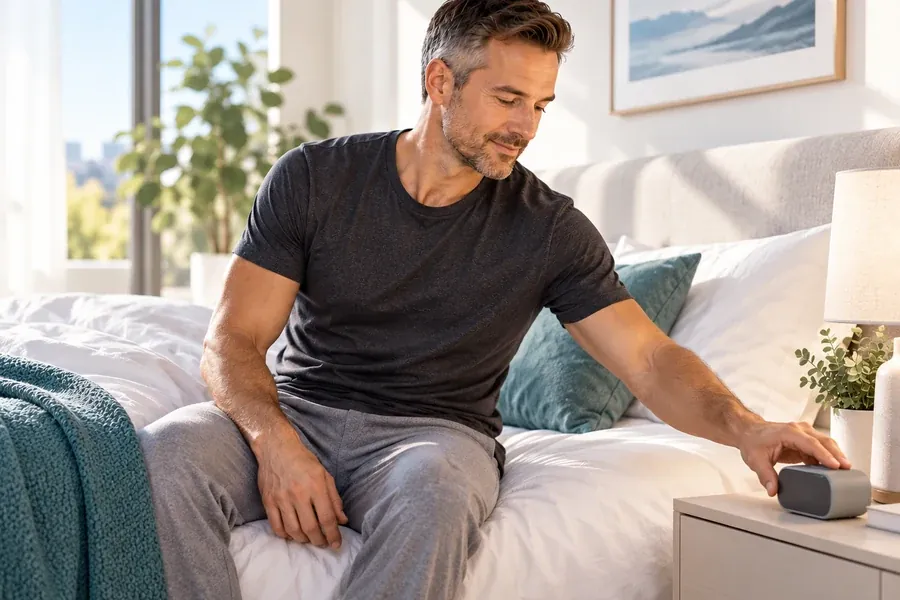
If you stabilise one thing, start with when you get up. You do not need military precision; avoid large day-to-day jumps.

Light is a major time cue for the body clock. Seek daylight soon after waking, ideally outdoors, and avoid unnecessarily bright lighting late in the evening.

Effects depend on dose and sensitivity. Controlled research shows that larger caffeine doses can impair sleep even many hours later. If sleep is restless, test an early-afternoon cut-off for two weeks.

Alcohol may make falling asleep feel easier, but systematic evidence shows changes in sleep architecture even at lower doses. Do not use it as a sleep strategy.

Regular physical activity generally improves subjective sleep quality. Evening exercise is not automatically harmful; monitor how hard late sessions affect your own sleep.

Dim the lights, write down unfinished tasks, prepare tomorrow’s essentials and switch to quieter activities. The goal is less decision load, not a perfect ritual.
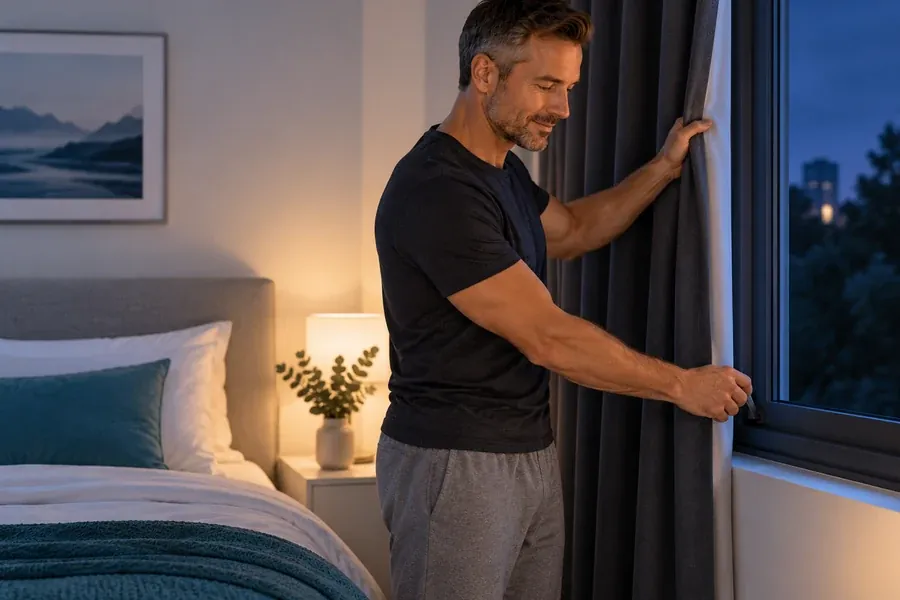
Dark, quiet and comfortably cool is the useful direction. Solve concrete problems such as noise, light, overheating or feeling cold before buying more trackers.

A smart ring estimates sleep stages algorithmically; it does not replace polysomnography. Look at multi-night trends. If tracking itself makes you anxious, less tracking may be the better intervention.
You do not need a ring to sleep better. If you want to observe longer-term sleep and recovery trends, these models are reasonable options already covered in FitRecover’s smart-ring material.

Oura states 5–8 days of battery life and tracks sleep, overnight heart rate, HRV and temperature trends. Detailed insights require an Oura membership.
Limit: expensive, ongoing membership for the full experience and not a medical diagnostic device.
Search exact model on Amazon.de* ↗
The manufacturer states 4–6 days of battery life, a weight from about 2.4 g and sleep, recovery and temperature trends. Core data do not require a mandatory monthly subscription according to the manufacturer.
Limit: also expensive; optional services may cost extra and the measurements remain estimates, not diagnoses.
Search exact model on Amazon.de* ↗* Affiliate links. Check size, colour, package contents and current offer details on Amazon before buying.
For healthy adults, regularly getting at least seven hours is an evidence-based minimum recommendation; many people function best around seven to nine hours. Individual need varies.
No. Regularity does not mean minute-by-minute precision. The goal is to avoid large, frequent shifts.
Not necessarily. Evidence is mixed. Reducing unnecessarily bright light and highly stimulating evening screen use is usually a more direct first step.
One score means little. Consider trends, daytime function and symptoms together. Consumer trackers are not diagnostic tools.
If you remember only three things: keep your rhythm steadier, manage light and caffeine more deliberately, and move regularly. Then work on details. The best plan is the one you can still follow on a stressful Wednesday.
Editorial limit: this article explains general sleep-hygiene and behavioural strategies. It does not diagnose a sleep disorder and does not replace CBT-I or medical/psychotherapeutic treatment.