Compare air purifiers: room size, CADR and running costs
Ten models for different rooms and priorities, assessed using linked manufacturer documentation. FitRecover has not performed its own laboratory or noise measurements.
Advertising: links marked * are affiliate links. As an Amazon Associate we earn from qualifying purchases.
Selection and interpretation
The numbers identify models in our existing selection; they are not measured performance scores. Room volume, desired air-change rate, usable fan setting and filter costs determine suitability. Conflicting or non-comparable specifications are identified explicitly.
Compare room size using the same calculation
Calculation, not a measurement: floor area ≈ CADR ÷ (ceiling height × desired hourly air changes). At 2.5 m and four air changes, 250 m³/h corresponds to about 25 m². This is a comparison example, not a medical recommendation. Maximum CADR usually applies to a high fan setting; sleep mode delivers less airflow. Different test standards and real room airflow limit precision.
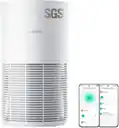
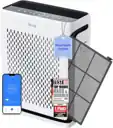
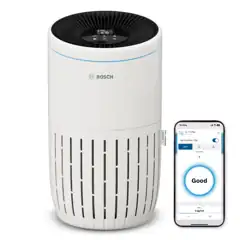
Use case: 266 m³/h, a PM2.5 sensor, four fan settings and app control. Approximately 27 m² at four air changes, for users wanting clear manual settings.
Limitation: The advertised 69 m² uses a different basis. We do not assign a separate health benefit to the optional UV function.
Care and running costs: The specified filter life is 4,320 hours: about 360 days at twelve hours daily as an illustration. Actual loading can require earlier replacement.
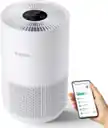
Use case: 230 m³/h particle CADR in a compact design. Our four-air-change estimate is 23 m²; the manufacturer’s 16–27 m² range uses a different calculation standard.
Limitation: 20 dB refers to sleep mode. It cannot be combined with maximum CADR as a simultaneous performance claim.
Care and running costs: Check replacement-filter availability and the app region for the unit you intend to buy.
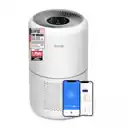
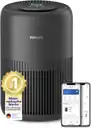
Use case: The manufacturer specifies a particle CADR of 250 m³/h: approximately 25 m² at four air changes and a 2.5 m ceiling.
Limitation: Match the full AC0951/13 model number; similarly named 900-series devices may have different features.
Care and running costs: Check the compatible original filter and its cost alongside the purchase price; particle performance does not establish gas removal.
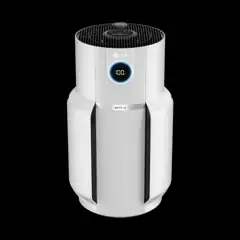
Use case: The manufacturer distinguishes 130 m² at one air change from 28 m² at 4.8 changes per hour. The smaller figure is more useful for performance comparison.
Limitation: “Up to five years” depends on specified test conditions, including 12 hours daily and an allowed CADR reduction. It does not mean maintenance-free.
Care and running costs: Clean the pre-filter and account separately for filters and the fragrance cartridge. Check cartridge use if you prefer no added fragrance.
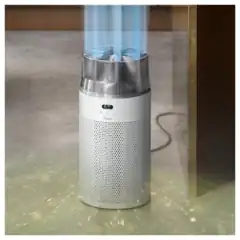
Use case: Compact design with app control and a particle/carbon filter. A small-bedroom option once the exact EU version is confirmed.
Limitation: The manufacturer page contains inconsistent room-size and noise figures. We therefore do not use a single CADR value or recommend it broadly for large rooms.
Care and running costs: Follow the filter indicator and actual loading; match replacement filters to the exact model.
Filters and electricity: a transparent cost example
Annual electricity cost = average power in kW × hours per day × 365 × electricity price. With illustrative assumptions: 20 W × 12 h × 365 × €0.35/kWh = €30.66 per year. A hypothetical €40 filter replaced every six months adds €80, giving €110.66 in total. These are calculation assumptions, not current prices or measurements of a listed model. Substitute your operating setting, tariff and exact replacement-filter price.
Limitations and your decision
An air purifier does not remove exhaled CO₂ or resolve damp and mould sources. A filter-material test is not a guarantee for an entire room. A noise figure without its fan setting does not allow a fair comparison.
Choose the cleaning output your room needs first. Then compare noise at that output and filter costs. A large advertised room size or long filter-life claim alone does not establish the best choice.
 FitRecover