
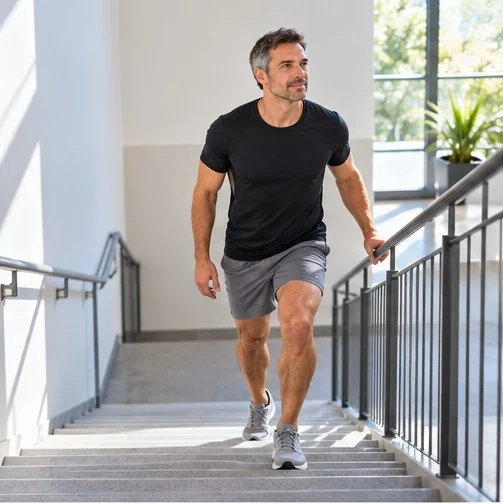
Why stairs are a useful place to train
As you climb, you lift your own body weight against gravity. Depending on your pace, step height and fitness, this can be considerably harder than walking on level ground. For many people, stairs are therefore an accessible way to add short periods of activity to everyday life.
You do not need a special machine. A clear, dry staircase with a firm handrail can be enough for a gradual start. The advantage is consistency: two floors on your way out, a carefully paced session after work or a short, separate workout at the weekend.
Distinguish everyday movement from structured training: Taking the stairs in daily life is already valuable activity. If you want to develop muscular endurance or cardiorespiratory fitness more specifically, also track your session frequency, number of climbs and effort without turning every journey into a competition.
Endurance
Pace, duration and breaks determine how much you challenge your breathing and cardiovascular system.
Legs
You lift your body weight from step to step, repeating a muscular effort.
Everyday life
You practise the same movement you use on the way to your home or a station platform.
What research and guidelines actually say
The WHO generally recommends 150–300 minutes of moderate or 75–150 minutes of vigorous aerobic activity per week for healthy adults, or a combination of the two, plus muscle-strengthening activity on at least two days. Short periods of activity count too; some activity is already better than none [1].
A 2025 randomised study examined short, vigorous stair intervals in young men with obesity. After four weeks, measured peak oxygen uptake (VO₂peak) improved, while body weight did not change significantly. This suggests that short stair-climbing efforts can improve endurance. It establishes neither predictable weight loss nor the suitability of vigorous intervals for everyone [2].
Another randomised study compared stair climbing with machine-based resistance training in older adults. It assessed muscular and functional performance, among other outcomes. Its findings cannot establish that stairs match a strength programme for every person and training goal [3]. Additional exercises for the major muscle groups remain useful for a balanced programme.
What this means when starting out
Short activity breaks count. The right dose depends on your fitness, how you feel that day and the staircase. Start with a manageable volume and progress only once you can complete the previous sessions safely.
When stair training makes sense and when to adapt it
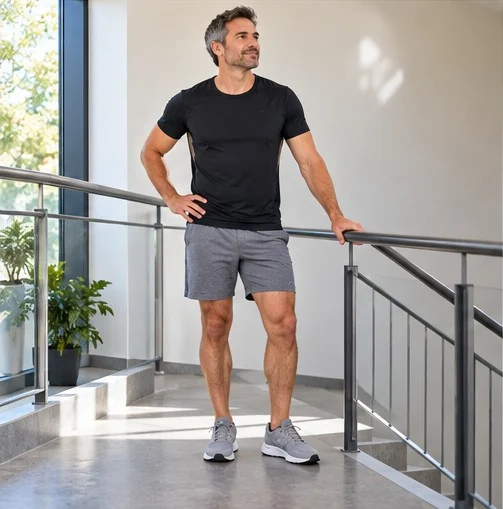
A practical starting point
To follow this plan, you should be able to walk short distances without unusual symptoms and climb up and down one floor in a controlled way. This is a practical guide, not a medical exercise test.
Choose supportive shoes, accessible and clear steps, good lighting and a stable handrail. Do not carry heavy bags. Other people always have priority on public stairs.
Pay particular attention to technique and concentration after a long working day or significant sleep loss. An active break on level ground may be more suitable in those circumstances.
Climb and descend with control
Climbing: steady rather than rushed
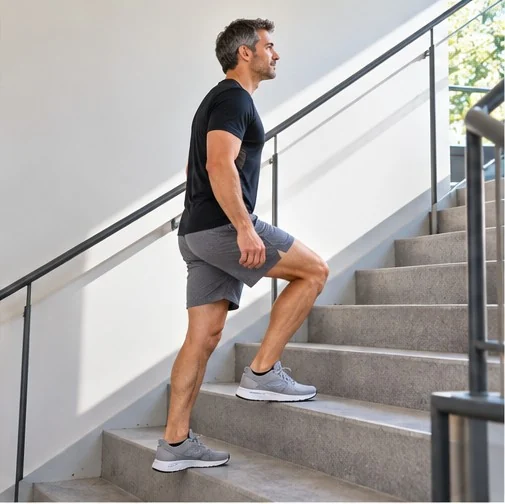
Place enough of your foot on the step to feel secure, including the heel where the tread depth allows it. Let your knees follow roughly the direction of your toes. Keep your torso tall and lean slightly forward with the movement. Take one step onto the next stair. Use the handrail for safety and keep breathing steadily.
Descending: put safety first
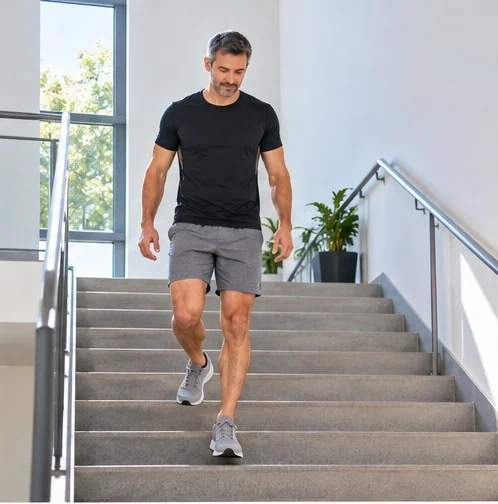
Walk down calmly and without rushing. Descending challenges the muscles that brake your movement and places different demands on balance and joints. Use the handrail or take the lift back down if needed, particularly with knee discomfort, fatigue or when you only want to train your climbing performance.
Turning: avoid abrupt changes of direction
Stand securely on the landing before turning around. During short intervals, the goal is a repeatable effort, not the fastest possible change of direction.
Pace: control before speed
If you can no longer place your feet accurately, pull hard on the railing or stamp on every step, you are going too fast or are already too tired. Reduce your pace or end the set.
How hard should stair training feel?
The hardest minute is not automatically the most productive. Start with a simple talk test: during moderate activity, you can usually talk but can no longer sing comfortably; during vigorous activity, you can only say a few words before pausing for breath. The CDC also recommends perceived effort on a 0–10 scale as a guide [4].
| Level | How it feels | Talking | In practice |
|---|---|---|---|
| Light · RPE 2–4 | Calm to slightly faster breathing | Full sentences are easy | Warm-up, technique and first sessions |
| Moderate · RPE 5–6 | Noticeably faster breathing, controlled steps | Talking is possible; singing is difficult | Controlled endurance sets |
| Vigorous · RPE 7–8 | Clearly strenuous | Only a few words before pausing for breath | Optional for experienced exercisers; not a goal of the starter plan |
RPE levels are practical guides, not fixed medical thresholds. Weather, medication, recovery and fitness affect both perceived and measured effort.
Do you need a chest strap? No. A chest strap can help you track comparable climbs over several weeks, but it replaces neither watching the steps nor your own sense of effort. Avoid staring at a watch or phone while moving.
For short intervals: You do not need a preset target heart rate for this starter plan. Do not speed up just to reach a number. First use secure footing, your ability to speak and perceived effort as your guides.
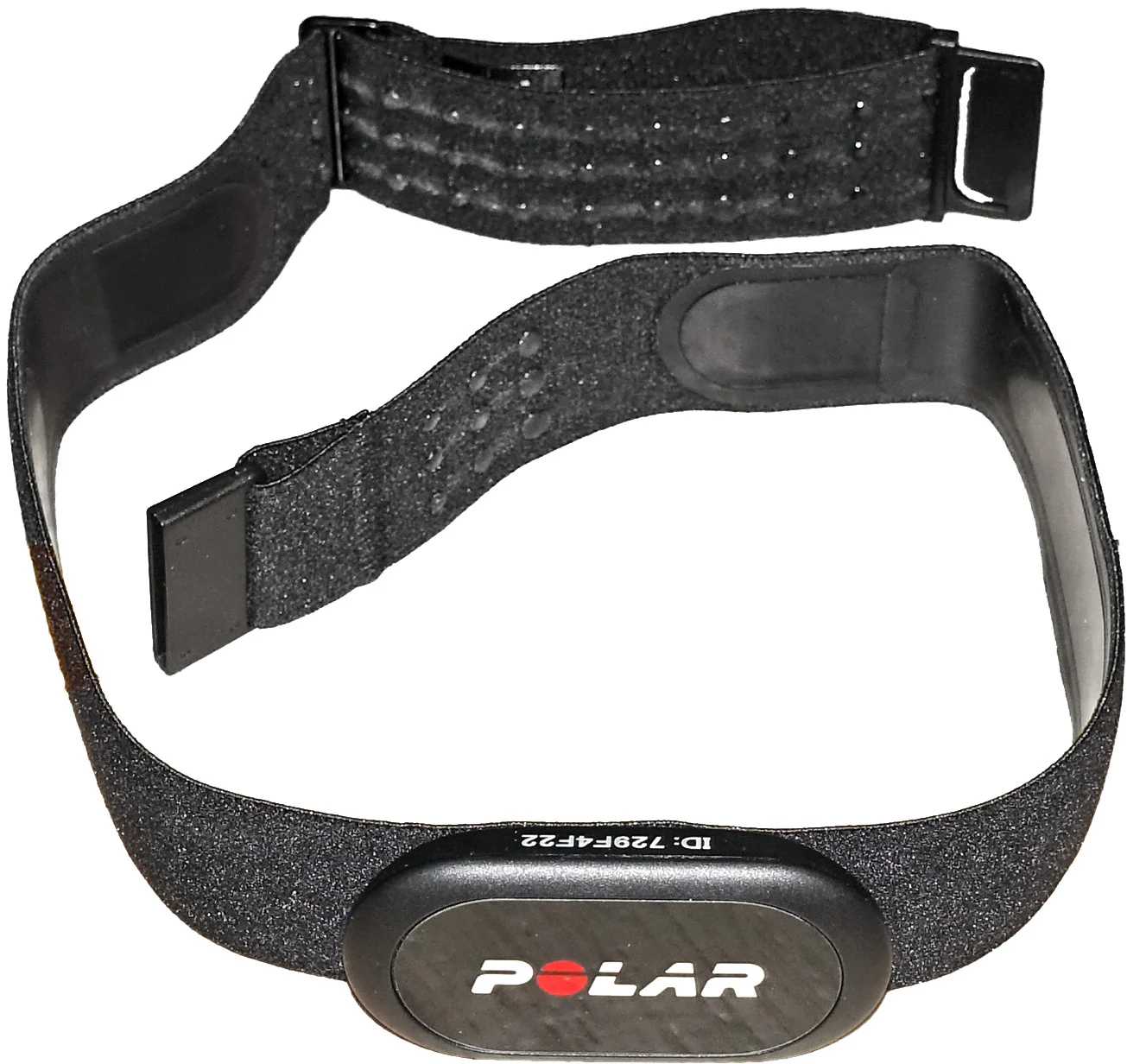
Polar H10 – track your effort over time
Who is it for? If you want to record your heart rate over several sessions and compare your climbs more easily. The chest strap sends readings to compatible devices using Bluetooth or ANT+.
What to check: Choose the correct strap size and check compatibility with your watch or app. Read the values on a safe landing or after the session; keep your eyes on the steps while climbing.
View on Amazon.de ↗As an Amazon Associate, we earn from qualifying purchases.
Product photo: Tiia Monto, Wikimedia Commons, CC BY-SA 3.0.
Four weeks that adapt to you
This plan is for generally healthy adults who can already manage one floor safely. Start at the lower end of the suggested amounts. Each week is a guide, not a compulsory target: you can repeat it or reduce the number of climbs.
How to read the plan
One climb = one floor up. Use the same staircase where possible and take one step at a time. A slow descent with the handrail or a lift journey brings you back; it does not count as an additional climb. Include the return journey in your recovery break. Start again only once you can speak calmly and feel sure-footed. As an initial guide, allow 60–120 seconds, or longer if needed.
| Week | Frequency | Per session | Effort | Your focus |
|---|---|---|---|---|
| 01 · Settle in | 2 days | 4 × 1 floor | Light, RPE 2–4 | A calm rhythm and safe climbing and descending. |
| 02 · Consolidate | 2 days | 4–5 × 1 floor | RPE 3–5; keep steps controlled | If well tolerated, add one climb while keeping the same pace and breaks. |
| 03 · Build up | 2 days | 5–6 × 1 floor | Mostly RPE 3–5 | Add at most one more climb without increasing your pace at the same time. |
| 04 · Repeat | 2 days | 5–6 × 1 floor | Light to moderate, no higher than RPE 6 | Keep volume steady. Only if everything feels easy, make one climb slightly faster. |
Leave at least one easier day between sessions, for example by training on Tuesday and Friday. Increase only one variable in a week: number of climbs, length, pace or frequency. Adding a floor to every climb can change the volume substantially; it is not automatically a small next step.
Ready for the next step?
- You place every foot securely and stay in control until the final climb.
- Effort stays within the planned range and breathing settles during breaks.
- The next day, neither pain nor severe soreness gets in the way of walking or using stairs.
If any of these points do not apply, repeat the current week or reduce the workload. After a longer break, restart at an easier level.
What your workout looks like in practice
- Warm up for 4–5 minutes: Walk gently on level ground, gradually increase your pace and move your ankles without pain.
- Climb one floor: Climb with control, breathe steadily and assess your effort on a safe landing.
- Return and recover: Descend slowly using the handrail or take the lift. You should be able to speak calmly before the next climb.
- Complete the planned number: The quality of your steps determines when to stop, not the desire for another round.
- Cool down for 2–3 minutes: Walk gently on level ground, then briefly record the number of climbs, effort and how well you tolerated the session.
Depending on the staircase and breaks, the whole session often takes around 12–20 minutes. Necessary recovery takes priority over that estimate.
Is one floor already too much? Start with walking intervals on level ground or a few well-supported steps. If your walking is unsteady or you have symptoms, choose an option supervised by a qualified professional.
After the introduction: progress with purpose
If you tolerate the introduction well, maintain stable technique and already train regularly, start with one small adjustment. Keep it for several sessions before progressing again.
- More total work: First add one more easy climb, keeping the number of floors unchanged.
- A little more pace: First make one climb slightly quicker, without sprinting. Keep the other climbs and recovery unchanged.
- Longer climbs: Add a second floor later and initially reduce the number of repetitions.
Do not change several variables at once. If your total training load is already high, an additional stair session should preferably replace part of your usual endurance training. On public stairs, keep your steps controlled and the handrail clear; sprints and jumps increase the risk to you and others.
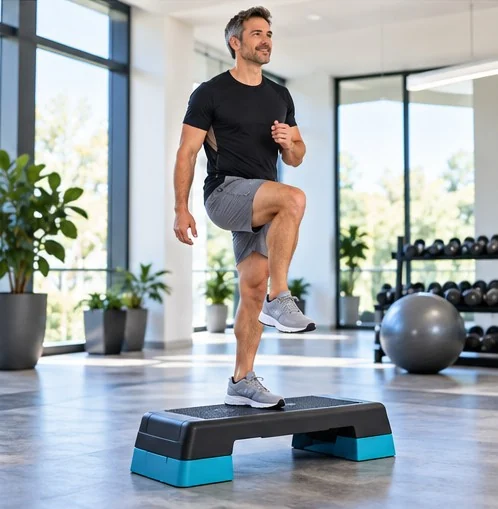
Add two short strength sessions
Combine stair training with exercises for the major muscle groups on at least two days per week [1]. Alongside chair stands, calf raises or a hip exercise, include suitable pulling and pushing movements for your upper body. The 2026 ACSM evidence overview supports regular, progressive resistance training in healthy adults [5]. Perform additional exercises on a safe, level surface.
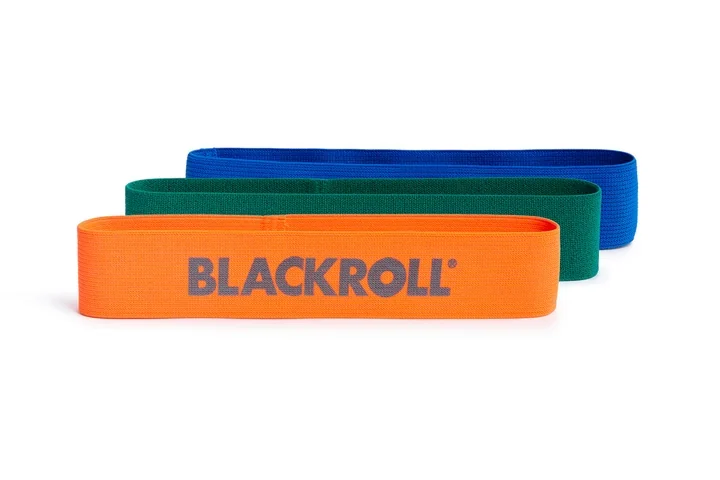
BLACKROLL LOOP BAND SET – complement your leg exercises
Who is it for? If you want to train your hip and leg muscles separately alongside stair climbing. The set contains three bands with different resistance levels.
Suitable use: Controlled side steps on level ground, for example during an additional strength session. Choose a resistance that lets you perform the movement cleanly.
Use the bands for separate exercises. Keep your legs free of bands when climbing or descending stairs.
View on Amazon.de ↗As an Amazon Associate, we earn from qualifying purchases.
Water within reach: choosing a bottle
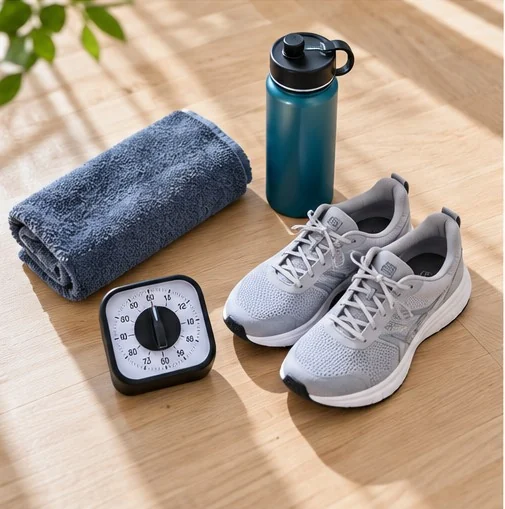
Place your bottle on a safe landing or beside the stairs without blocking anyone's path. Drink during breaks rather than while climbing or descending, leaving a hand free for the handrail.
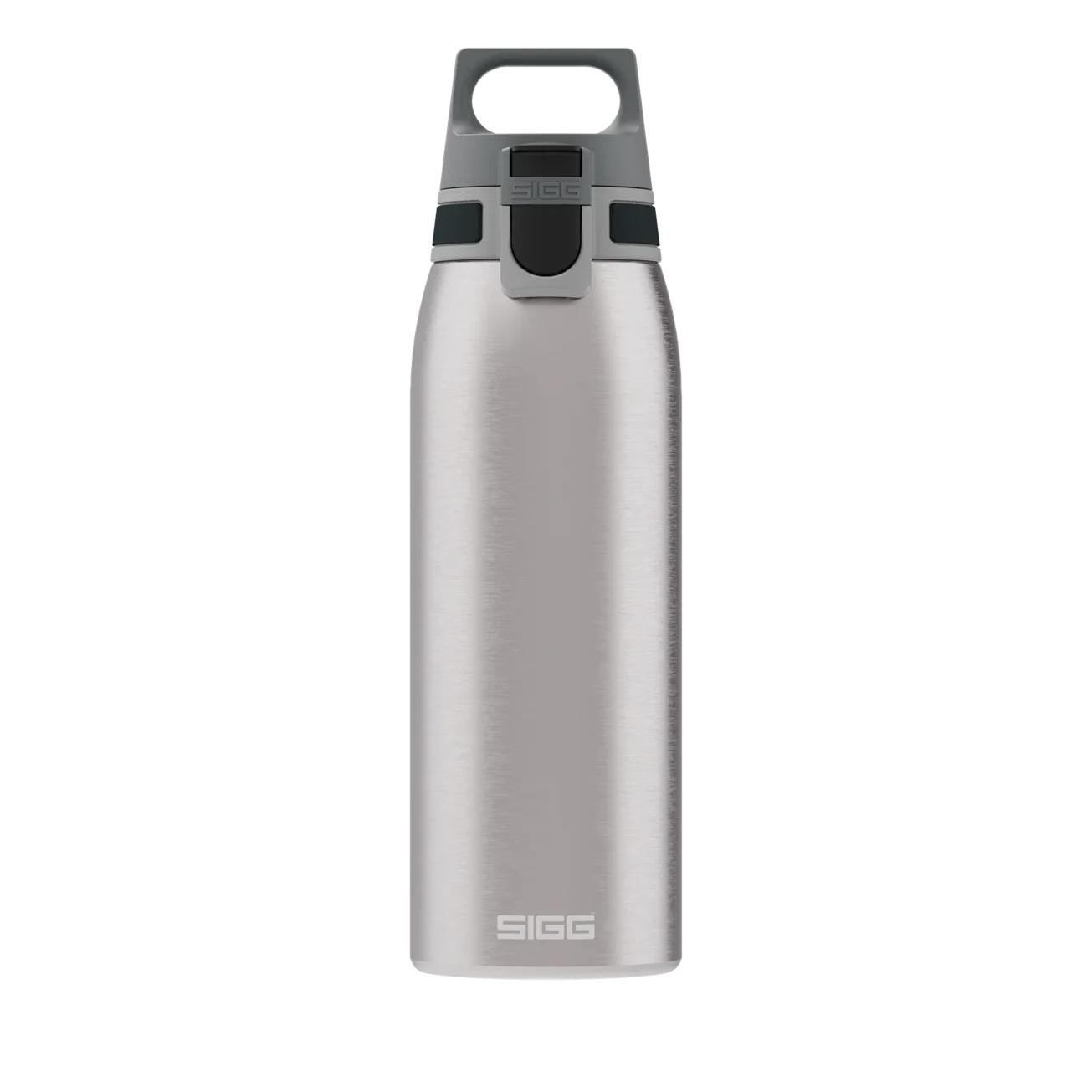
SIGG Shield ONE Brushed – 1 litre for your training break
Who is it for? If you are looking for a reusable stainless steel bottle for sport and daily life. The ONE cap opens at the push of a button; the single-wall bottle is suitable for water and, according to the manufacturer, carbonated drinks too.
What to check: This version has a single wall and no thermal insulation. Use it for water breaks and close the cap fully before carrying it.
View on Amazon.de ↗As an Amazon Associate, we earn from qualifying purchases.
Six mistakes that limit your training benefits
1. Pushing every session to breathlessness
If the warm-up already becomes a sprint, technique suffers. Keep most sessions controlled and plan brief harder sections only once you have a sound foundation.
2. Descending as fast as you climb
You fatigue differently on the way down. The risk of falling does not justify another interval during the return. If you feel unsure, slow down considerably or choose another way back.
3. Comparing only the number of floors
Step height and the number of stairs per floor vary. If useful, record climbing time, effort and breaks as well as the number of floors.
4. Using poor footwear or crowded stairs
Grippy, well-fitting shoes and clear steps are safety essentials. Wet outdoor stairs, darkness, rushing and oncoming traffic are unsuitable training conditions.
5. Dropping strength training entirely
Stairs challenge the legs and cardiovascular system but do not sufficiently train every major muscle group. A balanced strength programme remains useful.
6. Ignoring warning signs
Unusual chest pressure, severe dizziness and sudden breathlessness are not training effects to breathe your way through. New joint pain or swelling also calls for reducing the workload and seeking professional advice when appropriate.
Frequently asked questions
Are two stair sessions per week enough?
Two sessions are a sensible start, especially alongside walking, cycling or strength training. For overall health goals, weekly activity minutes and work for the major muscle groups also matter, following WHO guidelines.
Should I take two steps at a time?
Not in this programme. One step at a time makes the movement more predictable and the workload easier to manage. Taking bigger steps is not a necessary sign of quality.
Is stair training suitable for knee osteoarthritis?
There is no one-size-fits-all answer. Symptoms, range of movement, strength, fall risk and medical or therapeutic guidance all matter. Descending may be particularly uncomfortable. If symptoms persist, ask a qualified professional to adapt your training.
Is ten minutes of training useful at all?
Yes, short periods of activity can be useful. However, there is no guarantee that exactly ten minutes has the same effect as longer or more regular activity. Total volume, intensity and consistency matter.
Which is better: stairs, cycling or a treadmill?
The best option depends on what you tolerate, the space available and your motivation. Stairs can make good use of limited time but depend on the location, cycling is often easier to pace steadily, and a treadmill offers adjustable speed and incline. Many people benefit from combining options.
Which muscles work when climbing stairs?
The muscles that extend the hips and knees, together with the calves, do most of the work when climbing. The trunk helps stabilise the body. Repeated climbing challenges the legs but is not a complete strength workout for the whole body.
Can I train on stairs every day?
A few easy everyday steps are different from a demanding workout. Start with the two planned sessions and an easier day between them. Account for other sports, long walks and physical work before adding sessions.
Does stair training help with weight loss?
Stair climbing increases your physical activity. That alone cannot predict how your weight will change. The short-interval study cited here did not show significant weight loss either [2]. Initially judge progress by consistency, tolerance and endurance.
Your next step: start small and stay consistent
With clear, well-lit stairs, you can turn everyday movement into a small endurance programme. Begin at a calm pace, practise controlled climbing, deliberately slow down when descending and build volume before intensity. A short effort you can repeat regularly is more useful than a spectacular one-off sprint.
Your next practical step
Choose two training days this week with an easier day between them. After warming up, start with up to four calm climbs of one floor each. Afterwards, note the number of climbs, perceived effort and how your legs and joints feel the next day. If you tolerate this well, take the next small step.
Related FitRecover articles
Sources and context
- World Health Organization (2020): WHO Guidelines on Physical Activity and Sedentary Behaviour. General weekly recommendations and a gradual start.
- Han et al. (2025): Effect of brief intense stair climbing on cardiorespiratory fitness ... Randomised study of 24 young men with obesity; limited applicability to other groups.
- Van Roie et al. (2025): Stair-Climbing Versus Machine-Based Resistance Exercise ... Supervised randomised study in older adults.
- CDC (4 December 2025): How to Measure Physical Activity Intensity. Talk test and perceived effort.
- American College of Sports Medicine (18 March 2026): ACSM Resistance Training Position Stand – Science Spotlight.
- Polar: H10 – product information.
- SIGG: Shield ONE Brushed – product information.
- BLACKROLL: LOOP BAND – product and exercises.
Updated: 22 October 2026. Adapt the workload to your circumstances. This article provides general information and does not replace individual medical advice.
Advertising / affiliate links: As an Amazon Associate, we earn from qualifying purchases, at no extra cost to you. The labelled product links open Amazon.de.