
NUTRITION · MINERALS · GUIDE
Calcium: daily needs, foods and a Top 10 category comparison
Most adults can meet their calcium needs through food. What matters is a consistent total intake; a supplement becomes relevant when a real gap remains. This guide explains how to assess your diet and compare supplements sensibly.
For adults in Germany. Values for other ages provide context only. This is not an individual diagnosis or treatment recommendation.
Top 10 calcium selection by category
Advertising / affiliate links: As an Amazon Associate I earn from qualifying purchases. This does not add to your cost.
Three quick decision routes
The ten selection categories distinguish format, additional nutrients and portion size and may overlap. The specific examples come from the Doppelherz range. The editorial order considers calcium focus, a clear formulation and handling; it is not an Amazon sales ranking, a hands-on test or a comparison of effectiveness across brands. A higher position is not an individual recommendation to take a product. Amounts below are manufacturer figures per unit, not prescribed doses. Do not combine several examples.
| No. | Photo | Category and example | Calcium per unit | Context | Amazon.de |
|---|---|---|---|---|---|
| 1 | 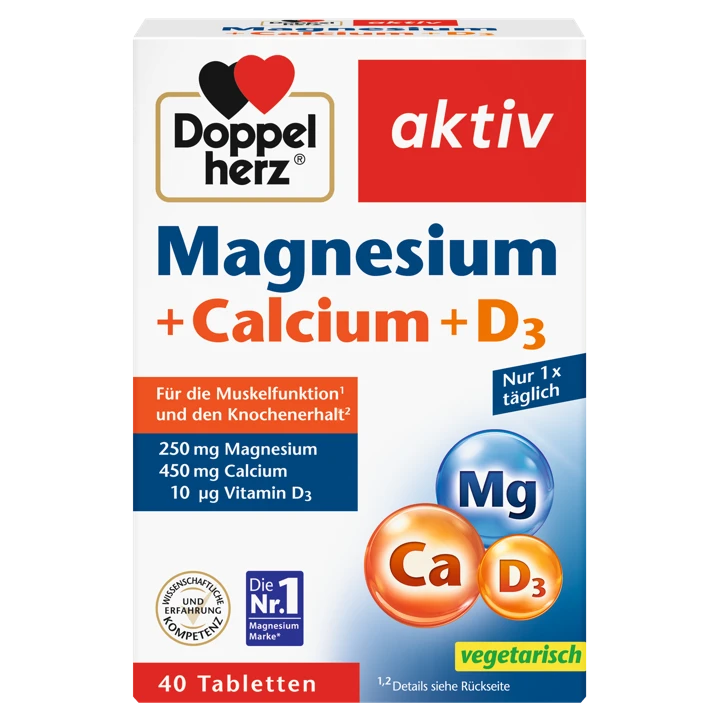 | Calcium–magnesium–D3 swallowable tablets Doppelherz Magnesium + Calcium + D3 40 tablets | 450 mg | Combines three nutrients without additional B vitamins or potassium. Limitation: Amounts cannot be adjusted separately. If only calcium is needed, or D3 and magnesium are already supplemented, other nutrients may be added unnecessarily. | View on Amazon* |
| 2 | 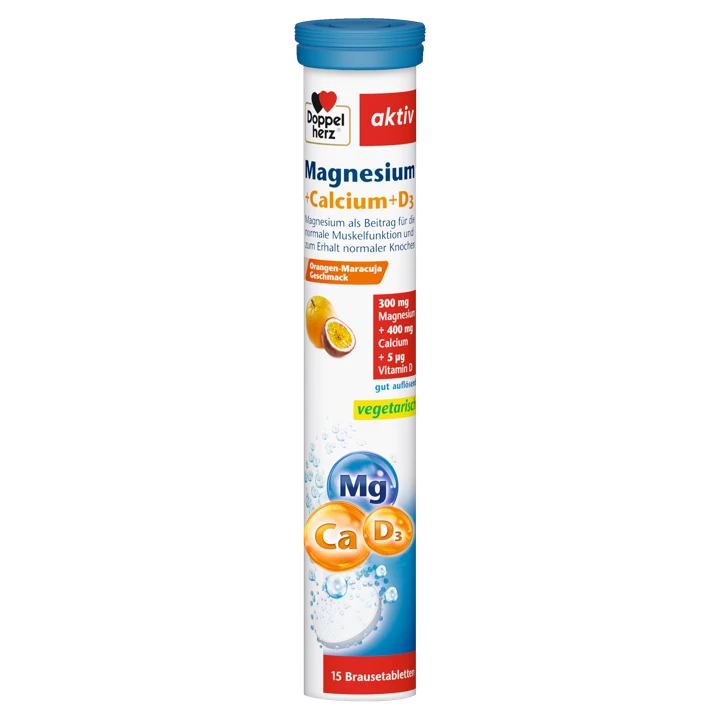 | Calcium–magnesium–D3 effervescent tablets Doppelherz Magnesium + Calcium + D3 Brausetabletten 15 effervescent tablets | 400 mg | Avoids swallowing a large solid tablet; the format can fit into a mealtime routine. Limitation: 300 mg magnesium exceeds the BfR proposed 250 mg maximum for supplements. Laxative effects are possible; sweeteners and flavour also need to suit you. | View on Amazon* |
| 3 | 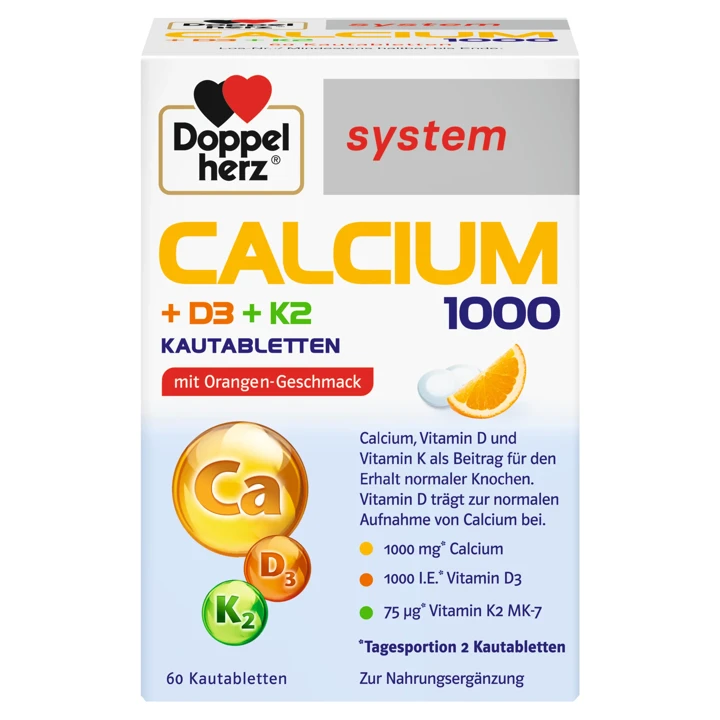 | Calcium–D3–K2 chewables Doppelherz system CALCIUM 1000 + D3 + K2 60 chewable tablets | 500 mg | Chewing or sucking provides an alternative to large swallowable tablets. Limitation: The full manufacturer serving exceeds the BfR proposal for calcium supplements. Contains sugar, sweeteners and a phenylalanine source. The manufacturer excludes children, adolescents and pregnant women. | View on Amazon* |
| 4 | 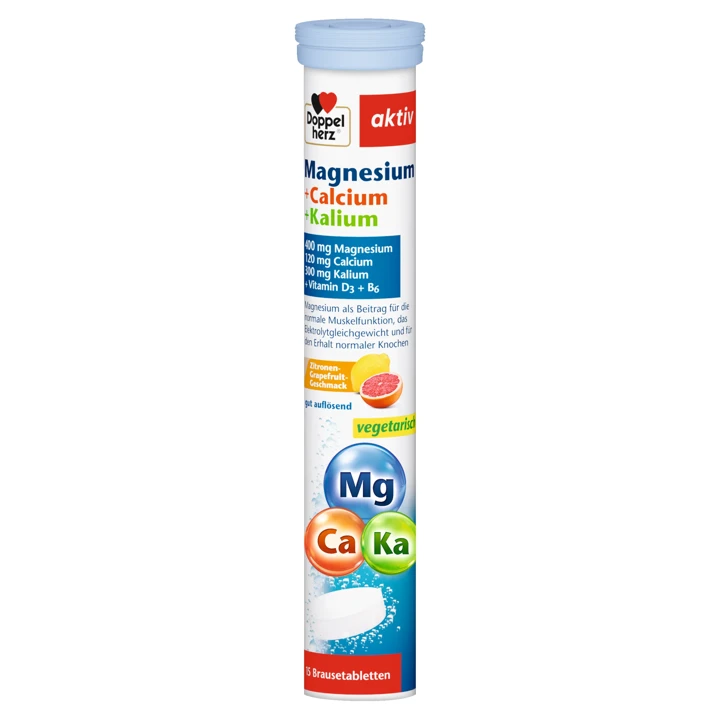 | Multimineral effervescents with potassium and B6 Doppelherz Magnesium + Calcium + Kalium + B6 + D3 15 effervescent tablets | 120 mg | Several minerals and vitamins in one dissolving portion. Limitation: Only 120 mg calcium; 400 mg magnesium exceeds the BfR proposal. The manufacturer advises medical discussion of potassium with kidney or heart disease. | View on Amazon* |
| 5 | 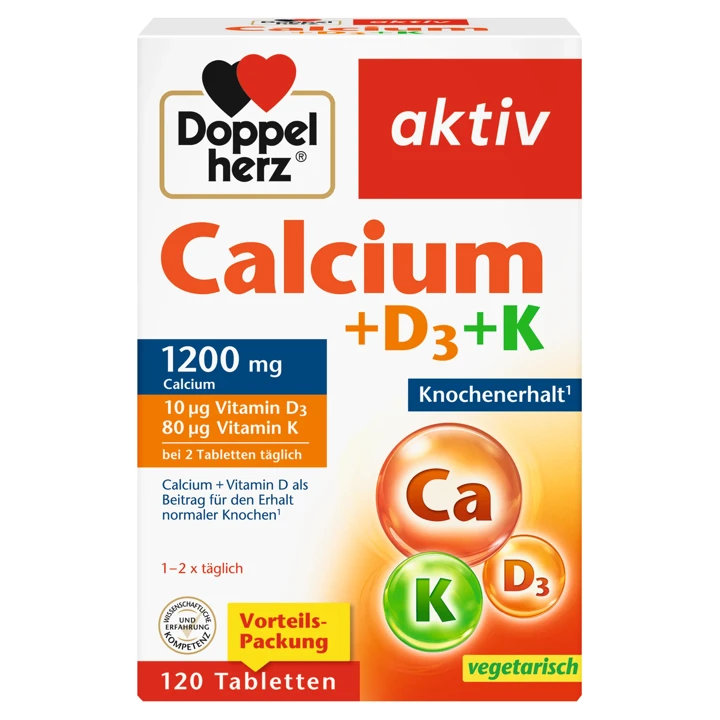 | Calcium–D3–K with a variable daily serving Doppelherz Calcium + Vitamin D3 + K 120 tablets | 600 mg | The label distinguishes one tablet from two; a large pack can serve an established routine. Limitation: Even one tablet exceeds the BfR proposed 500 mg maximum for calcium supplements. The higher manufacturer serving is not general self-treatment; consider kidney warnings and vitamin K interactions. | View on Amazon* |
| 6 | 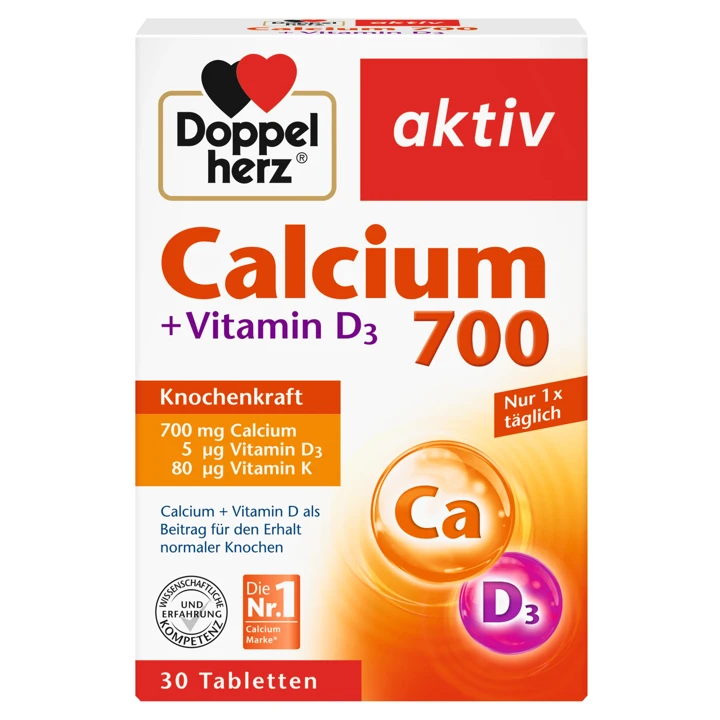 | Higher fixed-portion calcium–D3–K tablets Doppelherz Calcium 700 + Vitamin D3 30 tablets | 700 mg | One fixed declared portion without additional magnesium. Limitation: 700 mg supplemental calcium exceeds the BfR proposal. A poor match for small dietary gaps; review vitamin K and other supplements too. | View on Amazon* |
| 7 | 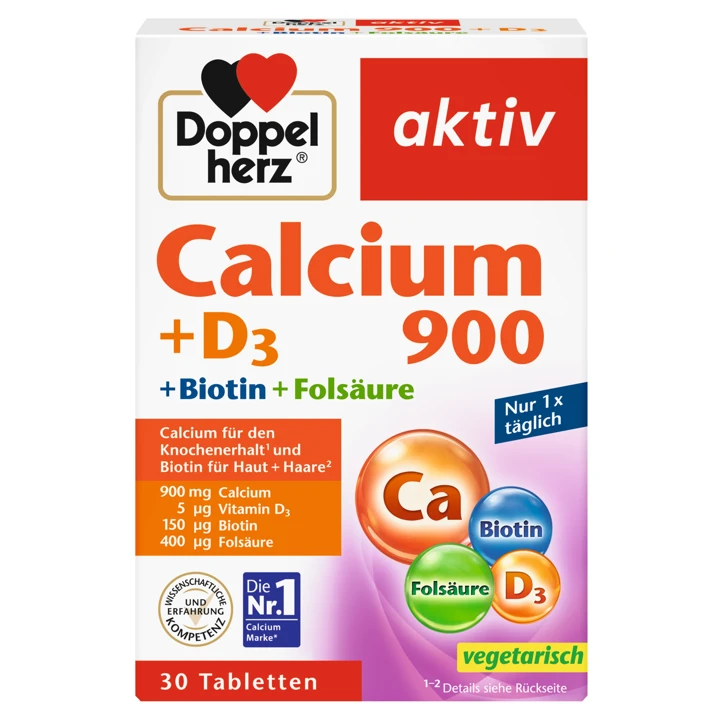 | Calcium–D3 with biotin and folic acid Doppelherz Calcium 900 + D3 + Biotin – Folsäure 30 tablets | 900 mg | Additional vitamins are explicitly listed, allowing comparison with an already justified combination plan. Limitation: 900 mg calcium is well above the BfR proposal. Biotin can affect laboratory results: mention use before tests. The manufacturer excludes people with swallowing difficulties and minors. | View on Amazon* |
| 8 | 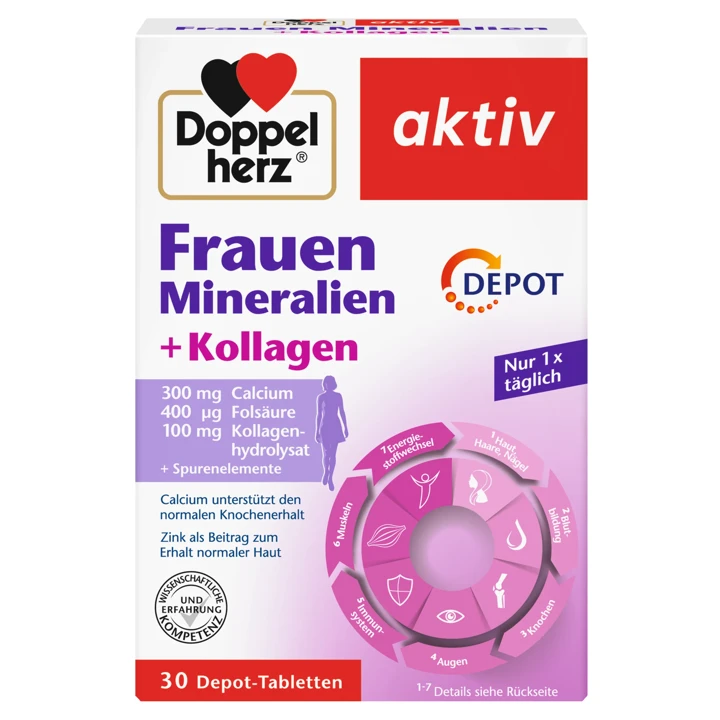 | Depot minerals with iron and folic acid Doppelherz Frauen Mineralien DEPOT + Kollagen 30 tablets | 300 mg | One serving combines several clearly declared nutrients for a matching agreed plan. Limitation: Not a calcium-only supplement. Iron and folic acid do not automatically match personal needs. Collagen makes it non-vegetarian; at 5 mg zinc the manufacturer warns against further zinc supplements. | View on Amazon* |
| 9 | 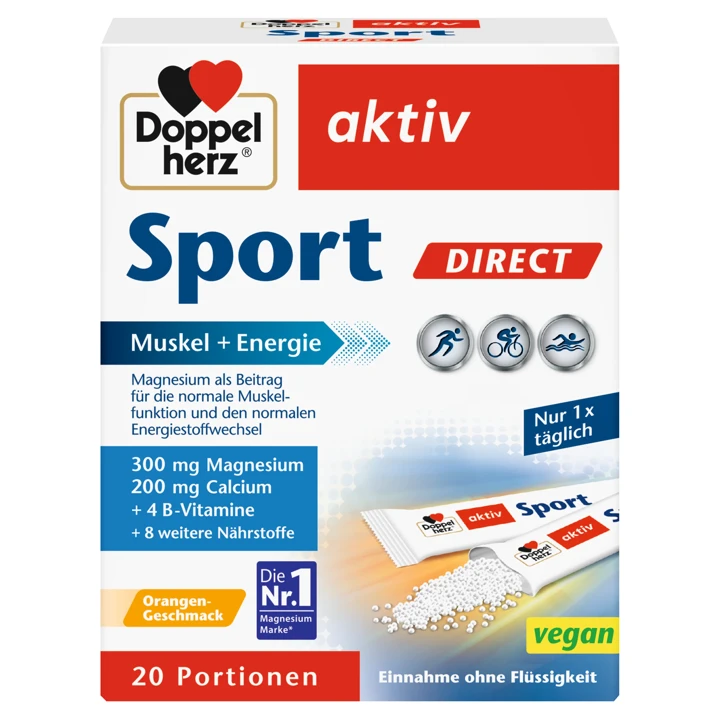 | Sports direct granules with several micronutrients Doppelherz Sport DIRECT 20 sachets | 200 mg | Portable measured sachets without a large tablet to swallow. Limitation: Not calcium alone. Magnesium exceeds the BfR proposal; include B6 and zinc from other supplements. Sorbitol can affect tolerance. | View on Amazon* |
| 10 | 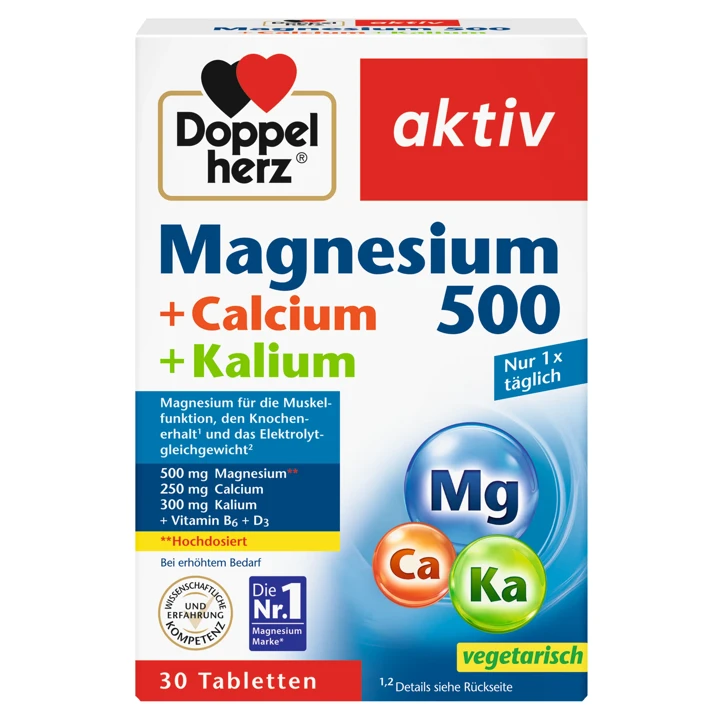 | Magnesium-focused calcium–potassium tablets Doppelherz Magnesium 500 + Calcium + Kalium 30 tablets | 250 mg | A clearly declared mixture when a particular magnesium plan is the explicit focus. Limitation: 500 mg magnesium is twice the BfR proposal. The manufacturer excludes minors, pregnant and breastfeeding women and people with impaired kidney function. Seek medical advice about potassium with kidney or heart disease. | View on Amazon* |
Is calcium a vitamin and what does it do?
Calcium is a mineral. It is needed for bones and teeth, muscle activity and communication between nerve cells. An essential role does not mean that extra amounts keep increasing performance. [1]
The useful question is therefore more practical than which tablet is strongest: which calcium sources are already a reliable part of your day? If you stop eating dairy, for example, plan its replacement deliberately instead of waiting for symptoms before thinking about supplements.
Calcium on a pack may be the main nutrient or part of a differently focused mixture. The complete composition matters more than the most prominent mineral word on the front.
Category 10
Magnesium-focused calcium–potassium tablets
Doppelherz Magnesium 500 + Calcium + Kalium
Calcium: 250 mg · Magnesium: 500 mg · Vitamin D: 20 µg (per unit). Pack contents: 30 tablets.[27]
Each tablet contains 250 mg calcium, 500 mg magnesium, 300 mg potassium, 20 µg vitamin D and 1.4 mg vitamin B6; 30 tablets.
Advantage: A clearly declared mixture when a particular magnesium plan is the explicit focus.
Limitation: 500 mg magnesium is twice the BfR proposal. The manufacturer excludes minors, pregnant and breastfeeding women and people with impaired kidney function. Seek medical advice about potassium with kidney or heart disease.
Who it may suit and who it may not: Not a general first choice for calcium supply. A more targeted product usually makes more sense for an isolated calcium gap.
Difference from the alternative: 250 rather than 120 mg calcium compared with category 4; a solid tablet with more magnesium and vitamin D.
View on Amazon*How much calcium do you need each day?
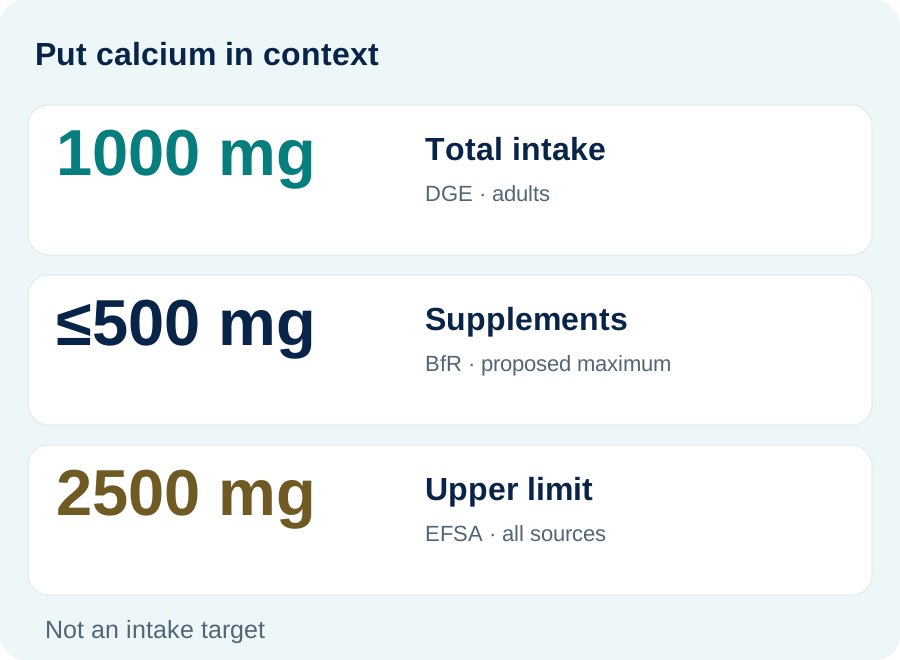
The German Nutrition Society, DGE, recommends 1000 mg a day from all sources combined for adults aged 19 and over. In Germany this also applies from age 65. It is not a tablet dose. The adult recommendation during pregnancy and breastfeeding is also 1000 mg. [2]
| Age / life stage | Calcium per day |
|---|---|
| 1–3 years | 600 mg |
| 4–6 years | 750 mg |
| 7–9 years | 900 mg |
| 10–12 years | 1100 mg |
| 13–18 years | 1200 mg |
| Adults aged 19+ | 1000 mg |
| Pregnancy / breastfeeding aged 19+ | 1000 mg |
The EU reference value used on labels is 800 mg instead. A tablet containing 400 mg therefore supplies 50% of the NRV but 40% of the DGE adult reference used here. Labelling NRVs, intake recommendations and individual prescriptions serve different purposes. [11]
Daily requirements cover all sources. A sports label does not create a separate universal calcium recommendation for every training day.
Category 9
Sports direct granules with several micronutrients
Doppelherz Sport DIRECT
Calcium: 200 mg · Magnesium: 300 mg · Vitamin D: 0 µg (per unit). Pack contents: 20 sachets.[26]
SPORT DIRECT provides 200 mg calcium, 300 mg magnesium and 4 mg vitamin B6 per sachet, plus other B vitamins and trace elements. 20 sachets, taken without water according to the manufacturer.
Advantage: Portable measured sachets without a large tablet to swallow.
Limitation: Not calcium alone. Magnesium exceeds the BfR proposal; include B6 and zinc from other supplements. Sorbitol can affect tolerance.
Who it may suit and who it may not: When a broad mixture is specifically justified; training alone does not justify this formulation.
Difference from the alternative: Less calcium than category 1 and no equivalent D3 trio; instead a broader mix of vitamins and trace elements.
View on Amazon*Which foods provide calcium?
Milk and yogurt provide roughly 120 mg per 100 g; cheese varies substantially by type. Calcium-rich mineral water and fortified plant drinks can make planning easier. Label values are especially useful for drinks and tofu. [1][5]
| Food | Portion | Calcium per portion | Context |
|---|---|---|---|
| Milk | 200 ml | approx. 240 mg | Approximate value |
| Yogurt | 200 g | approx. 240 mg | Approximate value |
| Gouda | 30 g | approx. 240 mg | Varies by type |
| Fortified plant drink | 200 ml | 240 mg | If labelled 120 mg/100 ml |
| Mineral water | 1 litre | 300 mg | If labelled 300 mg/L |
These figures are approximate values or clearly identified label examples. Mineral water is usually listed in mg per litre, whereas plant drinks generally use mg per 100 ml. A drink with 120 mg/100 ml therefore provides 240 mg in 200 ml. An unfortified drink is not automatically a nutritional replacement.
Vegetables remain useful parts of the diet, but do not have to carry the whole calcium supply alone. Oxalate limits the absorption of calcium from spinach, so a high figure in a food table does not always mean an equally useful source. [18]
A dairy-free diet needs a suitable calcium replacement, but does not automatically require iron or collagen. Food choices and other nutrient questions need separate assessment.
Category 8
Depot minerals with iron and folic acid
Doppelherz Frauen Mineralien DEPOT + Kollagen
Calcium: 300 mg · Magnesium: 200 mg · Vitamin D: 5 µg (per unit). Pack contents: 30 tablets.[25]
Frauen Mineralien DEPOT + Kollagen: per tablet, 300 mg calcium, 200 mg magnesium, 5 µg vitamin D, 5 mg iron, 400 µg folic acid and 100 mg collagen hydrolysate; also vitamin C and zinc.
Advantage: One serving combines several clearly declared nutrients for a matching agreed plan.
Limitation: Not a calcium-only supplement. Iron and folic acid do not automatically match personal needs. Collagen makes it non-vegetarian; at 5 mg zinc the manufacturer warns against further zinc supplements.
Who it may suit and who it may not: For adults whose needs match the complete mixture; a product name aimed at women does not itself justify taking it.
Difference from the alternative: Less calcium than category 1, but adds iron, folic acid and collagen. Depot release does not prove better bone outcomes.
View on Amazon*Two practical examples without a calcium tablet
With dairy: 200 ml milk providing 240 mg, 200 g yogurt providing 240 mg, 30 g Gouda providing about 240 mg and one litre of mineral water labelled 300 mg/L add up to roughly 1020 mg. These are calcium building blocks for a day, not a complete meal or drinking plan. Other foods contribute as well. [1][5]
Plant based, with matching labels: 400 ml fortified plant drink at 120 mg/100 ml provides 480 mg; 150 g tofu labelled 200 mg/100 g provides 300 mg; one litre mineral water at 250 mg/L provides 250 mg. Total: 1030 mg. The tofu value is a calculation assumption, not a standard value for every tofu.
Choose building blocks you already enjoy eating or drinking. If milk does not agree with you, a tolerable replacement is more useful long term than a theoretically perfect plan abandoned after two days. Do not increase water intake independently if you have a prescribed fluid restriction.
The daily examples show how calcium from food and drinks can add up. Adding 900 mg is a separate decision, not an automatic extra for every eating plan.
Category 7
Calcium–D3 with biotin and folic acid
Doppelherz Calcium 900 + D3 + Biotin – Folsäure
Calcium: 900 mg · Magnesium: 0 mg · Vitamin D: 5 µg (per unit). Pack contents: 30 tablets.[24]
Each tablet contains 900 mg calcium, 5 µg vitamin D, 150 µg biotin and 400 µg folic acid; 30 tablets.
Advantage: Additional vitamins are explicitly listed, allowing comparison with an already justified combination plan.
Limitation: 900 mg calcium is well above the BfR proposal. Biotin can affect laboratory results: mention use before tests. The manufacturer excludes people with swallowing difficulties and minors.
Who it may suit and who it may not: Only for a justified need for this combination. Too extensive and highly dosed for an ordinary small calcium gap.
Difference from the alternative: Unlike category 6, contains biotin and folic acid instead of vitamin K, with more calcium per unit.
View on Amazon*When might a supplement make sense?
A supplement can be useful when intake remains inadequate and suitable foods cannot close the gap. Conditions affecting absorption, osteoporosis treatment and care dependency call for a clinical decision. For most people without particular risks, calcium and vitamin D tablets are not a general insurance policy against fractures. [6]
- Record three typical days, including a weekend day.
- Estimate calcium from foods, drinks and supplements you already use.
- Check whether a simple food swap closes the recurring gap.
- If a gap remains, discuss an appropriate amount and your existing medicines with a clinician or pharmacist.
Calculation example: A diet providing about 750 mg leaves a numerical gap of 250 mg against the reference. This is not an automatic prescription; it explains why routinely adding a 1000 mg tablet may miss the actual need.
A numerical 250 mg gap does not automatically call for a 700 mg serving. Comparing the product with the usual diet comes before buying.
Category 6
Higher fixed-portion calcium–D3–K tablets
Doppelherz Calcium 700 + Vitamin D3
Calcium: 700 mg · Magnesium: 0 mg · Vitamin D: 5 µg (per unit). Pack contents: 30 tablets.[23]
Each tablet contains 700 mg calcium, 5 µg vitamin D and 80 µg vitamin K; 30 tablets. The manufacturer recommends taking it with a meal.
Advantage: One fixed declared portion without additional magnesium.
Limitation: 700 mg supplemental calcium exceeds the BfR proposal. A poor match for small dietary gaps; review vitamin K and other supplements too.
Who it may suit and who it may not: For an assessed higher supplementation need; not a default choice because the label says 700.
Difference from the alternative: More calcium and vitamin K per tablet than category 5, in a smaller pack.
View on Amazon*Calcium citrate or calcium carbonate?
Both can provide calcium. Compare the declared elemental calcium, conditions for taking it and tolerability. The mass of the entire compound is not the amount of calcium it contains. [16]
| Form | Practical use | Consideration |
|---|---|---|
| Calcium carbonate | With a meal | More dependent on stomach acid; may be more likely to cause constipation. |
| Calcium citrate | Can also be taken without food | Less dependent on stomach acid; often needs more compound for the same calcium amount. |
Start with the line labelled calcium per tablet or daily serving. A large calcium-citrate figure on the front is not very useful without it. If a clinician prescribes a larger supplemental amount, splitting it may matter: portions up to 500 mg are absorbed more efficiently as a percentage than very large single doses. That is not advice to add 500 mg. [15]
The calcium compound and the portion size are separate questions. After checking ingredients, establish whether the nutrient table describes one tablet or several.
Category 5
Calcium–D3–K with a variable daily serving
Doppelherz Calcium + Vitamin D3 + K
Calcium: 600 mg · Magnesium: 0 mg · Vitamin D: 5 µg (per unit). Pack contents: 120 tablets.[22]
Each tablet contains 600 mg calcium, 5 µg vitamin D and 40 µg vitamin K; 120 tablets. The manufacturer lists one tablet, or two with a low-calcium diet: then 1200 mg calcium.
Advantage: The label distinguishes one tablet from two; a large pack can serve an established routine.
Limitation: Even one tablet exceeds the BfR proposed 500 mg maximum for calcium supplements. The higher manufacturer serving is not general self-treatment; consider kidney warnings and vitamin K interactions.
Who it may suit and who it may not: When this exact combination is professionally justified; not for a small gap or someone who must avoid vitamin K supplementation.
Difference from the alternative: 600 rather than 700 mg calcium per tablet in category 6; taking two substantially changes the total dose.
View on Amazon*What is vitamin D's role?
Vitamin D supports calcium absorption. Adequate calcium intake and adequate vitamin D status belong together, but need separate assessment. Taking vitamin D does not automatically mean you need extra calcium. [1][7]
If you already take vitamin D, check the total from all products before buying a combination. Combining nutrients can be convenient when both amounts fit. It is inflexible when only one nutrient needs adding. Follow the individually agreed plan for a diagnosed deficiency or medical treatment.
Taking vitamin D does not establish a need for every other ingredient. Review a broad mixture in the same way: which nutrients are actually missing, and which are already being supplemented?
Category 4
Multimineral effervescents with potassium and B6
Doppelherz Magnesium + Calcium + Kalium + B6 + D3
Calcium: 120 mg · Magnesium: 400 mg · Vitamin D: 5 µg (per unit). Pack contents: 15 effervescent tablets.[21]
Each tablet contains 120 mg calcium, 400 mg magnesium, 300 mg potassium, 5 µg vitamin D and 1.4 mg vitamin B6.
Advantage: Several minerals and vitamins in one dissolving portion.
Limitation: Only 120 mg calcium; 400 mg magnesium exceeds the BfR proposal. The manufacturer advises medical discussion of potassium with kidney or heart disease.
Who it may suit and who it may not: For an assessed need for the entire mixture; not a precise replacement for a large calcium gap.
Difference from the alternative: Much less calcium than category 2, plus potassium and B6.
View on Amazon*Which format helps when swallowing tablets is difficult?
When swallowing is difficult, the format deserves its own decision. Chewables, dissolving tablets and direct granules are different options; none automatically makes a high daily amount necessary.
Category 3
Calcium–D3–K2 chewables
Doppelherz system CALCIUM 1000 + D3 + K2
Calcium: 500 mg · Magnesium: 0 mg · Vitamin D: 12.5 µg (per unit). Pack contents: 60 chewable tablets.[20]
Each chewable contains 500 mg calcium, 12.5 µg vitamin D3 and 37.5 µg vitamin K2. The manufacturer's two-tablet daily serving contains 1000 mg calcium.
Advantage: Chewing or sucking provides an alternative to large swallowable tablets.
Limitation: The full manufacturer serving exceeds the BfR proposal for calcium supplements. Contains sugar, sweeteners and a phenylalanine source. The manufacturer excludes children, adolescents and pregnant women.
Who it may suit and who it may not: Only when the format and full daily serving match a professionally agreed plan. Seek advice with phenylketonuria or anticoagulant use and follow manufacturer warnings.
Difference from the alternative: No magnesium as in categories 1 and 2; instead vitamin K2 and a different format.
View on Amazon*What does this mean for training and bone health?
Movement, muscle strength and adequate nutrition all matter for bone health. A calcium tablet cannot replace these foundations. Appropriate loading and balance training can also help prevent falls. With osteoporosis or previous fractures, activity needs to suit the individual. [8]
A consistent eating routine on training days is a useful starting point. Alongside individual supplements, check whether you are skipping meals or removing entire food groups. This guide does not prescribe a special athlete dose or an individual training programme.
How much is too much and which medicines matter?
The BfR proposes no more than 500 mg calcium per day from supplements in total. For products providing more than 250 mg per daily serving, it recommends a warning against taking further calcium supplements. This is a precautionary proposal for supplements, not a personal intake target. [3]
EFSA gives adults a tolerable upper intake level of 2500 mg daily from all sources. This is not a goal either. Prescribed treatment and medical conditions require separate assessment. [13]
Constipation and other digestive effects can occur. Do not self-supplement with kidney disease, previous kidney stones or high calcium results. Automatically cutting calcium-rich foods because of a calcium stone can also be counterproductive. [16][14]
Calcium can interfere with the absorption of certain medicines, including levothyroxine and some antibiotics. For levothyroxine, the medicine information cited by NIH specifies four hours away from calcium carbonate. This is not a universal rule for every medicine: ask a pharmacist to check your exact schedule. [17]
Risk assessment goes beyond calcium: other ingredients can determine tolerance too. With an effervescent product, read the whole nutrient table.
Category 2
Calcium–magnesium–D3 effervescent tablets
Doppelherz Magnesium + Calcium + D3 Brausetabletten
Calcium: 400 mg · Magnesium: 300 mg · Vitamin D: 5 µg (per unit). Pack contents: 15 effervescent tablets.[10]
Each tablet provides 400 mg calcium, 300 mg magnesium and 5 µg vitamin D. The manufacturer specifies 200 ml water for dissolving it.
Advantage: Avoids swallowing a large solid tablet; the format can fit into a mealtime routine.
Limitation: 300 mg magnesium exceeds the BfR proposed 250 mg maximum for supplements. Laxative effects are possible; sweeteners and flavour also need to suit you.
Who it may suit and who it may not: Conditionally for adults with an agreed combination need and good tolerance; less suitable for a sensitive gut or calcium alone.
Difference from the alternative: Less calcium, more magnesium and less vitamin D than category 1. Dissolving does not establish greater effectiveness.
View on Amazon*Which choice fits your situation?
- Regular calcium-rich foods: Assess the total first; a tablet is not automatically necessary.
- Dairy free or vegan: Plan fortified alternatives and use labels. Plant based alone says nothing about calcium content.
- A small recurring gap: Choose a suitable food building block or a professionally agreed small supplement.
- Medicines, kidney disease or osteoporosis: Check against your personal treatment plan before adding a combination product.
The best choice may be to buy nothing and add a reliable food source instead. For supplements, a suitable amount matters more than the size of the container.
The decision guide leads to a simple rule: identify the actual gap, then choose a matching combination. Neither the biggest pack nor the largest figure on the front replaces that assessment.
Category 1
Calcium–magnesium–D3 swallowable tablets
Doppelherz Magnesium + Calcium + D3
Calcium: 450 mg · Magnesium: 250 mg · Vitamin D: 10 µg (per unit). Pack contents: 40 tablets.[9]
Each tablet provides 450 mg calcium, 250 mg magnesium and 10 µg vitamin D. A straightforward three-nutrient combination for an already agreed supplementation plan.
Advantage: Combines three nutrients without additional B vitamins or potassium.
Limitation: Amounts cannot be adjusted separately. If only calcium is needed, or D3 and magnesium are already supplemented, other nutrients may be added unnecessarily.
Who it may suit and who it may not: For adults whose needs match all three components; also consider a suitable single-nutrient product for calcium alone.
Difference from the alternative: More calcium and less magnesium than category 2, but the tablet must be swallowed.
View on Amazon*Common questions
Does a normal blood calcium result prove my diet is adequate?
No. Blood calcium is tightly regulated and does not reliably reflect long-term intake. Reviewing usual foods is more useful for diet planning; abnormal blood results require medical assessment. [4]
Do muscle cramps mean I need calcium?
Cramps alone do not establish calcium deficiency. Recurring symptoms need assessment rather than self-treatment with ever-higher mineral doses.
Is a high dose better for bones?
Not automatically. The aim is to correct inadequate supply. The tolerable upper limit is not a recommendation to maximise daily intake. [3][13]
Can I give these adult products to a child?
Do not use this guide to dose supplements for children. Age-specific intake values are not product recommendations; involve a paediatric clinician if a dietary gap is suspected.
Can I combine two calcium supplements?
Add up all supplement amounts first. When a product supplies more than 250 mg calcium per daily serving, the BfR recommends not taking further calcium supplements. [3]
Start with your regular calcium sources. If a gap remains, choose an appropriate amount and form with professional support, and consistently add up combination products.
Sources and further reading
Scientific background: DGE, BfR, EFSA, NIH and IQWiG. Product composition comes from the manufacturer. The selection assesses practical suitability and does not claim original laboratory testing or medical review.
- DGE · Calcium FAQ ↗
- DGE · Calcium Referenzwerte ↗
- BfR · Calcium Höchstmengenvorschläge ↗
- NIH ODS · Calcium Health Professional Fact Sheet ↗
- IQWiG · Wie kann ich meinen Kalziumbedarf decken ↗
- IQWiG · Osteoporose und Knochenbrüche ↗
- IQWiG · Vitamin D Bedarf ↗
- IQWiG · Die Knochen stärken und Brüchen vorbeugen ↗
- Doppelherz · Magnesium + Calcium + D3 · 40 Tabletten ↗
- Doppelherz · Magnesium + Calcium + D3 · 15 Brausetabletten ↗
- EU 1169/2011 · Annex XIII · Calcium NRV ↗
- BfR · Magnesium Höchstmengenvorschläge ↗
- EFSA · Summary of Tolerable Upper Intake Levels ↗
- IQWiG · Vorbeugung von Nierensteinen ↗
- Mayo Clinic · Calcium supplements timing ↗
- NIH ODS · Calcium Consumer Fact Sheet ↗
- FDA · Levothyroxine prescribing information ↗
- NHS · Calcium food sources ↗
- NIH ODS · Vitamin K ↗
- Doppelherz system CALCIUM 1000 + D3 + K2 ↗
- Doppelherz Magnesium + Calcium + Kalium + B6 + D3 ↗
- Doppelherz Calcium + Vitamin D3 + K ↗
- Doppelherz Calcium 700 + Vitamin D3 ↗
- Doppelherz Calcium 900 + D3 + Biotin – Folsäure ↗
- Doppelherz Frauen Mineralien DEPOT + Kollagen ↗
- Doppelherz Sport DIRECT ↗
- Doppelherz Magnesium 500 + Calcium + Kalium ↗