
TRAINING · CALISTHENICS · MOBILITY
How to structure a workout: warm-up, strength and mobility
Do you arrive at the park or unroll your mat before deciding what to train? A clear sequence helps you spend your time on what matters. This guide combines preparation, strength and mobility into a session you can adapt to your goal and schedule.
A useful plan answers three questions: What am I trying to improve today? What level of effort can I manage? How will I recognise progress next time? A small selection of repeatable exercises, appropriate difficulty and enough recovery give you a practical starting point.
Advertising / affiliate links: As an Amazon Associate I earn from qualifying purchases. This does not change your price. Links lead to Amazon Germany.
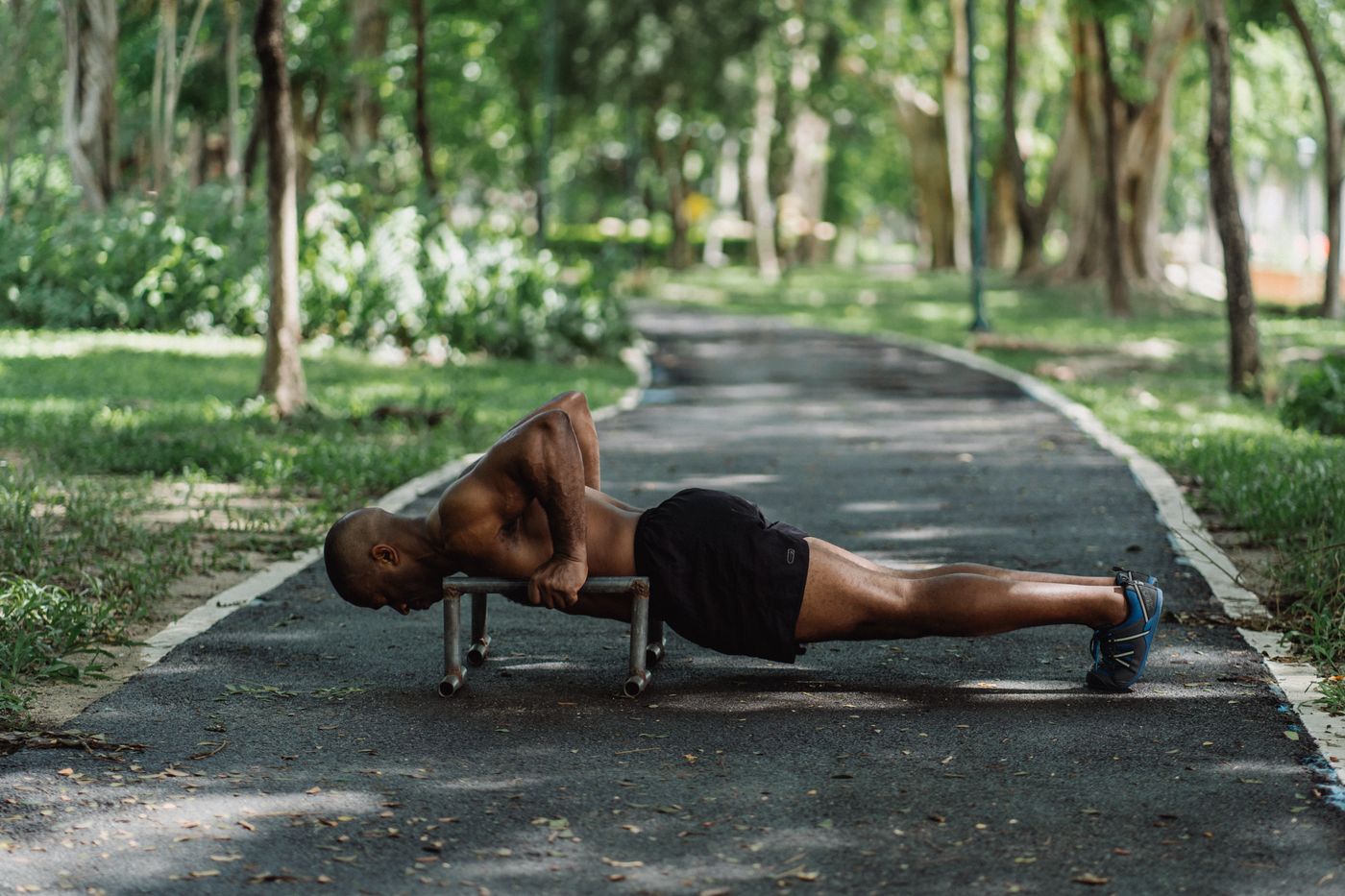
Give each part of the workout a purpose
This guide draws on Gödrösi Ádám’s video “Nem több gyakorlatra van szükséged, hanem erre!”. He describes five components: general warm-up, joint preparation, skill practice, strength work, and stretching or mobility. His examples mainly come from bodyweight training.
The schedules below are FitRecover’s own practical examples, not a transcription of his programme. You do not need all five components every time. If learning gymnastics skills is not a goal, leave that block out and use the time for strength work, recovery or a shorter session.
1. General warm-up: ease into movement
Start with about three to five minutes of easy walking, marching or relaxed steps. Add controlled shoulder circles, comfortable trunk rotations and a few easy squats. Gradually use the range you can control. You should feel warmer without feeling tired.
The video starts with the trunk before moving out towards the limbs. This is one possible routine, not a universal requirement. Prepare the areas you will use: legs and hips before squats, and shoulders and wrists before push-ups. In cold weather, after prolonged sitting or when you still feel stiff, take longer. Five minutes is a starting point, not a guarantee of readiness.

2. Specific preparation: light resistance and control
This phase is sometimes called prehab. Here it means preparation for the planned load, not treatment or a promise to prevent injury. Choose two or three relevant movements:
- Wrists: place your hands against a wall or solid raised surface and gently shift your weight. Start with very little pressure.
- Shoulder blades: use a wall or elevated support to practise controlled scapular movement with elbows mostly straight. Start with five to eight repetitions.
- Shoulder rotation: keep your elbow close to your side and use a very light band for six to ten controlled repetitions per side.
- Legs and hips: add a few unloaded squats and hip hinges before lower-body work.
Preparation should leave you ready, not exhausted. Before a demanding main exercise, add one or two much easier practice sets. These are separate from the challenging working sets.
3. Skill practice: optional and focused
Handstands, L-sits and front levers are skills with their own prerequisites and progressions. The video puts them before strength work. This can be a practical arrangement when skill development is your priority.
Choose one skill and allow five to ten minutes. Use short, controlled attempts with recovery between them. A supported seated leg lift or a basic support with feet on the ground can precede an L-sit. A full front lever is not a general beginner exercise, and a free handstand is not compulsory for fitness.
If strength is the main goal, prioritise your key strength exercise or practise skills separately. Research on resistance exercise order supports placing priority exercises early, but does not establish a universal order for all gymnastics skills. [2]
4. Strength: a few repeatable movement patterns
Build around a pushing movement, a pulling movement and a leg exercise. Add hip extension and trunk work when useful. Elevated push-ups, band rows, squats to a bench, glute bridges and dead bugs offer adjustable starting points.
Start with one or two working sets per exercise and usually six to twelve controlled repetitions. Stop while you could still perform about two or three good repetitions. This is an effort guide, not a requirement to test your absolute limit. For holds, position quality matters more than an impressive time.
Allow roughly 60 to 120 seconds between challenging sets and longer when needed. Heavy sets may need two to three minutes or more. Alternating pushing and pulling does not remove shared demands on the shoulders and trunk: supersets do not automatically replace recovery.
For healthy adults, ACSM recommends training the major muscle groups on at least two days each week as a basic starting point. Gym machines are not essential. [1]
5. Mobility: match the work to your goal
Reserve two to five quiet minutes for areas where you want more comfortable range. This might mean gentle chest and shoulder work after upper-body training, or a comfortable calf or hip-flexor stretch after leg work.
One possible start is one or two rounds of 20–30 seconds in each chosen position, without bouncing or sharp pain. You do not need to stretch every muscle after every workout. A separate short mobility session can be easier to schedule for a specific goal.
Skipping post-workout stretching does not automatically make you progressively stiffer. Resistance training using external loads can also improve range of motion. [3] Stretching is not a guarantee against soreness or overload.
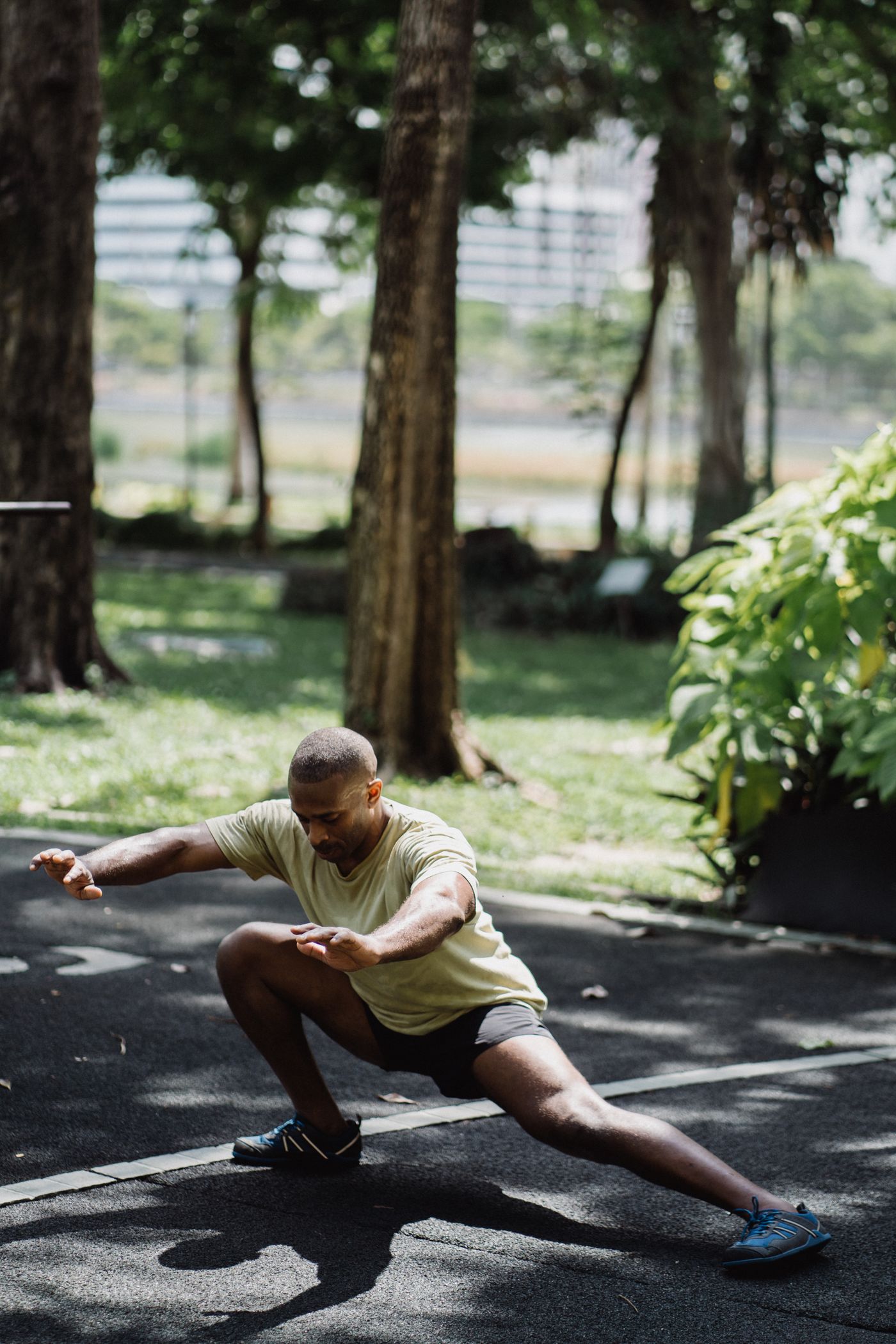
Choose a 20-, 30- or 60-minute session
These time windows include rests and transitions. If you need more time, remove a set or exercise rather than rushing every repetition.
| Block | 20 minutes | 30 minutes | 60 minutes |
|---|---|---|---|
| General warm-up | 3 min | 4 min | 6 min |
| Specific preparation | 2 min | 3 min | 6 min |
| Skill practice (optional) | – | 4 min | 10 min |
| Strength including rests | 13 min | 16 min | 32 min |
| Mobility / quiet finish | 2 min | 3 min | 6 min |
20 minutes: elevated push-ups, band rows and squats to a bench; one or two sets each as rests allow. 30 minutes: two sets of those three movements, plus an easy trunk set if time remains. 60 minutes: two or three sets per main movement, plus bridges and dead bugs. Without skill practice, use that time for strength recovery or finish earlier.
A simple beginner strength block
These are FitRecover examples, not a prescribed routine from the video. Choose a variation that lets you stay controlled.
| Pattern | Easy variation | Starting guide | Key point |
|---|---|---|---|
| Push | Push-up on a solid raised surface | 1–2 × 6–12 | Keep trunk controlled; raise the support if needed. |
| Pull | Long-band row | 1–2 × 8–12 | Use a suitable secure anchor; return slowly. |
| Legs | Squat to a solid bench | 1–2 × 6–12 | Secure bench against sliding; stand up smoothly. |
| Hip (optional) | Glute bridge | 1–2 × 8–12 | Extend hips without arching the lower back. |
| Trunk (optional) | Short-lever dead bug | 1–2 × 4–6 per side | Breathe; limit movement to what you can control. |
Turn a session into a repeatable plan
Record the exercise variation, sets, repetitions and effort. For example, begin with the same simple full-body session on Monday and Thursday, leaving at least one easier day between demanding sessions for the same muscles.
Once you reach the upper end of your chosen repetition range in every set with good control and some reserve, change one variable: a little more band tension, a lower push-up surface or a slightly harder variation. Your repetitions may then drop again. More sets are another option, not an obligatory weekly increase.
If performance stays below normal for several sessions, look at sleep, total activity and recovery. Physically demanding work also contributes to fatigue. Reduce training volume when appropriate instead of adding exercises to compensate for every difficult day.
Common mistakes
- Turning preparation into exhaustion: light drills should leave energy for the main work.
- Too many priorities: several new skills and a large strength programme rarely fit a short session.
- Only pushing: plan pulling and leg work deliberately.
- Removing every rest: slow down or recover when movement quality deteriorates.
- Changing everything weekly: keep some main exercises consistent so progress is comparable.
Which equipment is useful?
Buy equipment to solve a specific problem. A safe training area and a solid raised push-up surface already offer options. Pulling exercises require a suitable resistance source or a purpose-built secure setup. Our product suggestions are functional choices, without hands-on testing or a ranking. Check current variants and prices on Amazon.
A light open band is often easier to adjust for shoulder drills than a strong assistance band. Rings add options but require an appropriate anchor and more control. A very soft mat may be comfortable for kneeling and too yielding for challenging supports.
Who should adapt this approach?
These examples are for generally healthy adults with a general fitness goal. Returning exercisers can begin with easier variations and fewer sets. Experienced athletes need more individual loading for demanding skills and sporting goals.
Recent injury, surgery or persistent symptoms call for individual professional guidance. Stop an exercise if you develop sharp pain, numbness or increasing joint symptoms. End the workout and seek appropriate assessment for chest pain, marked breathlessness or dizziness.
Frequently asked questions
Do I need 15 minutes of prehab every time?
No. Match preparation to the planned session. A short relevant selection and easy practice sets can be more practical than a fixed long routine.
Can 20 minutes be enough?
Yes, for a deliberately limited session with a few main movements. Multiple demanding skills, many sets and long rests need more time or additional days.
Must every set reach failure?
No. Beginners can use controlled repetitions with some reserve to make effort easier to manage.
Must I stretch after every session?
No. Choose mobility work for your own movement goals rather than treating it as a compulsory finishing ritual.
What should I buy first?
A suitable mat if you need a floor surface, then an adjustable band if it adds useful exercises. Buy rings or handles when you have a clear use and safe setup.
Make your workout repeatable
Choose your priority, prepare the relevant movements and leave enough time for a few quality working sets. Treat skill practice as a specific goal and mobility as targeted work. Record what you did so the next session builds on it.
Sources and editorial context
The linked video was analysed through its complete timestamped transcript. Session examples, dosage suggestions and product selection: FitRecover editorial team. This is not individual coaching or therapy. Product images: existing FitRecover catalogue; training photographs: Pexels. Updated 19 November 2026.
- ACSM (2026): resistance training recommendations
- Nunes et al. (2021): resistance exercise order
- Alizadeh et al. (2023): resistance training and range of motion