
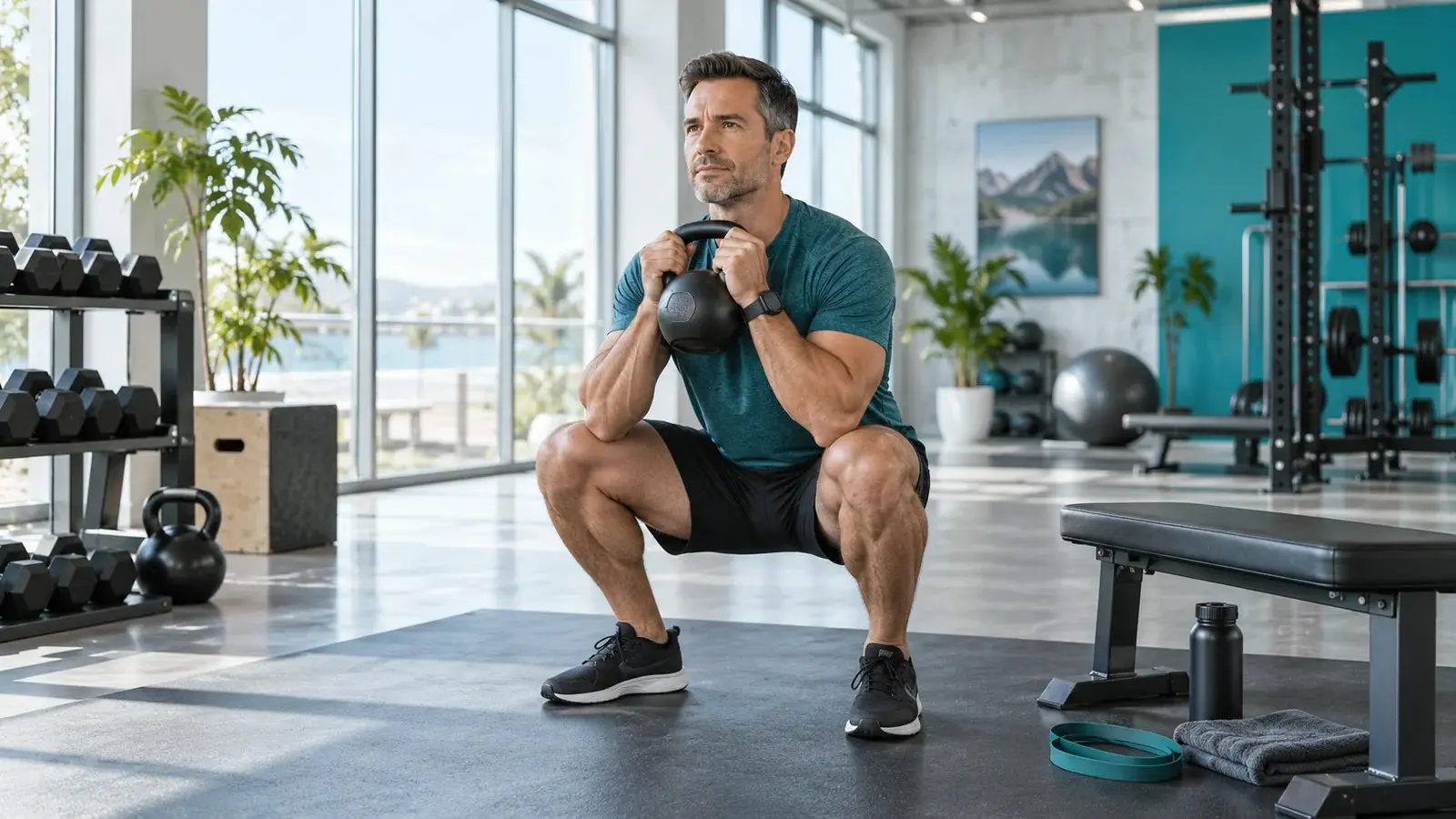
Why strong glutes and legs matter
Standing up, climbing stairs, lifting something off the floor, slowing down or catching your balance: your lower body produces force and controls it at the same time. Regular resistance training can improve muscular strength, muscle mass and physical performance. The updated 2026 ACSM recommendations particularly emphasise consistency: a suitable programme you can sustain matters more than unnecessarily complicated methods.
The aim of this article: not to make training as spectacular as possible, but to challenge the major lower-body muscle groups comprehensively and progressively. To do this, we combine squats, hip extension, hip hinges, single-leg movements, lateral hip work and calf raises.
Glute muscles
The gluteus maximus extends the hip, for example when standing upright or stepping up. The lateral glute muscles help control the pelvis during steps and single-leg loading.
Front of the thighs
The quadriceps straighten the knee and work hard during squats, standing up, step-ups and controlled lowering.
Back of the thighs
The hamstrings assist hip extension and knee flexion. Hip-hinge movements such as the Romanian deadlift provide a training stimulus that can be adjusted readily.
Calves
The calves generate push-off through the foot and work with every step. Slow calf raises allow you to train this often-overlooked area directly.
Strength training can therefore support daily life, sport and movement control. However, it is not a guarantee against joint problems or injuries. Appropriate loading, sound technique and adequate recovery remain essential.
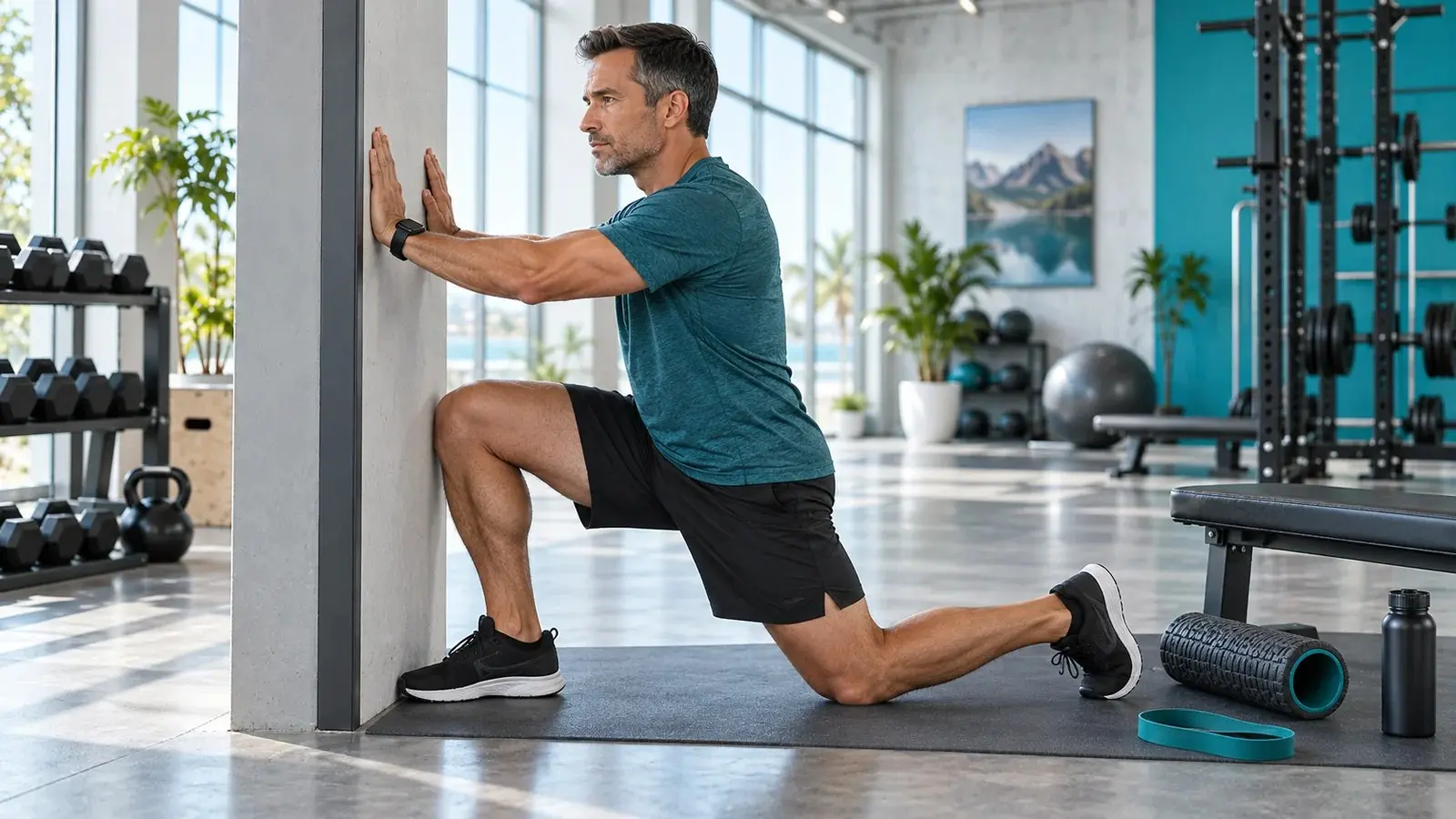
5 minutes of preparation for your ankles, knees and hips
You do not need a long mobility programme. Simply prepare the movements you are about to strengthen.
- 2 minutes: walk gently, march on the spot or cycle lightly.
- Ankles: keeping your whole foot on the floor, move your knee forwards with control 6–8 times per side.
- Knees: 8 small supported squats, initially using a short range of motion.
- Hips: in a split stance, make 6 small, calm forwards-and-back movements per side.
The 7 key exercises for your glutes and legs
Choose a variation you can perform with control. The harder version is not compulsory; it is simply an option for progressing later.
Chair squat or goblet squat
Glutes · QuadricepsStand in front of a stable chair with your feet about hip- to shoulder-width apart. Move your hips and knees back and down together, touch the chair with control and stand up again. Your knees and toes may point in similar directions.
- Easier: use a higher seat or hold on lightly.
- Harder: progress to an unsupported squat, then a goblet squat with a kettlebell or dumbbell.
- Common mistake: forcing depth and losing heel contact or control.
2 sets of 8–12 repetitions. Lower calmly and stand up powerfully, but without swinging.
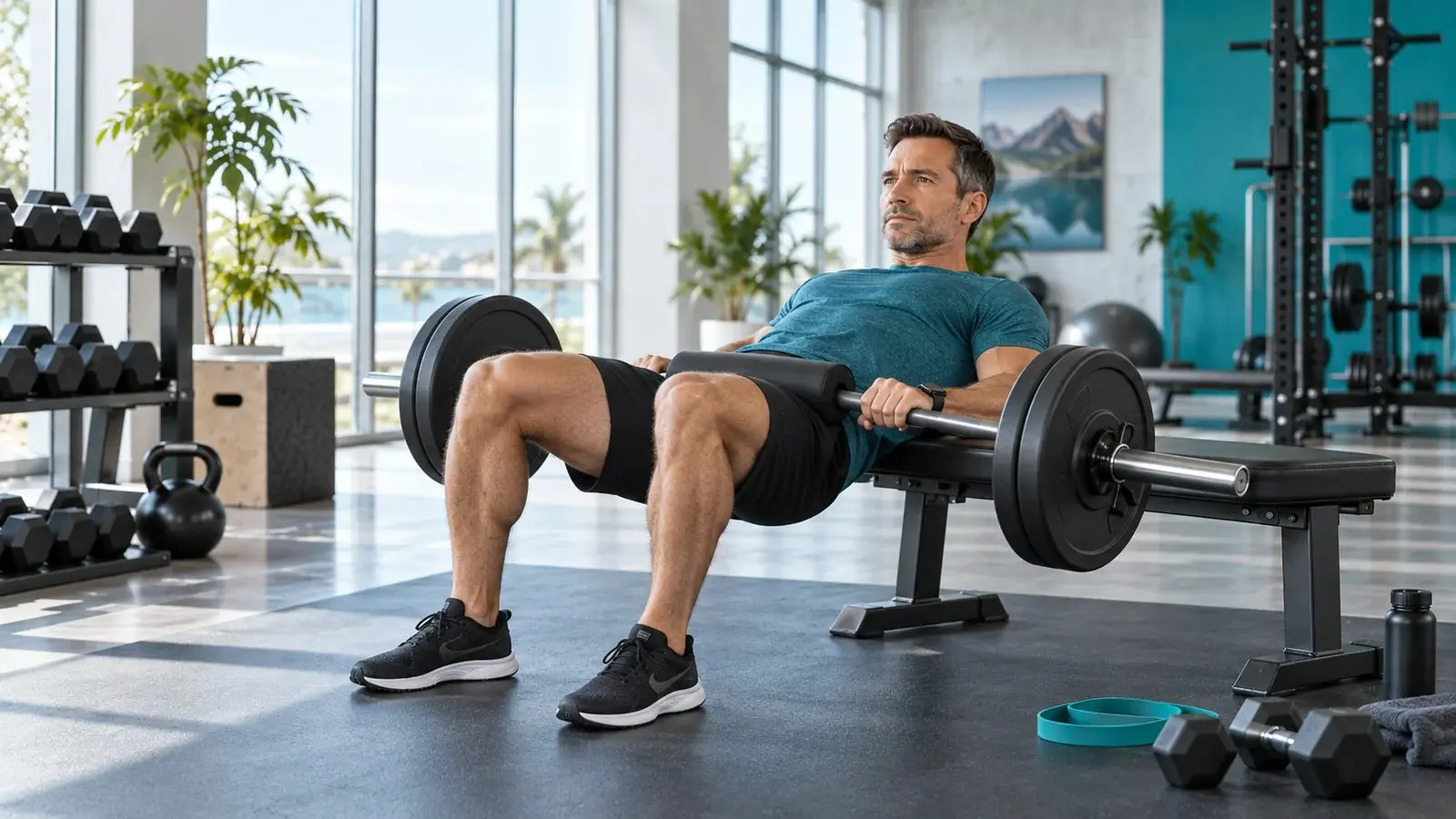
Glute bridge and hip thrust
Glutes · Hip extensionFor a glute bridge, lie on your back, plant both feet and lift your pelvis by extending your hips firmly. Gently engage your abdomen and stop before compensating with an arch in your lower back.
- Easier: use a smaller range of motion or take a short break between repetitions.
- Harder: hold the top position for two seconds, add a mini band above your knees or later perform a hip thrust against a secure bench.
- Common mistake: pushing as high as possible even though the movement is already coming from your lower back.
2 sets of 10–15 repetitions. Deliberately squeeze your glutes at the top, then lower slowly.
Hip hinge and Romanian deadlift
Glutes · HamstringsBend your knees slightly and push your buttocks backwards as your upper body tilts forwards as one unit. When you add dumbbells, keep them close to the front of your legs. Stand up through your hips; the weights do not have to reach the floor.
- Easier: practise the unweighted hip hinge in front of a wall.
- Harder: add two dumbbells or a kettlebell.
- Common mistake: turning the movement into a deep squat or rounding your back under load.
2 sets of 8–12 repetitions. Use only the range in which you can control your trunk and hips.
Supported reverse lunge
Glutes · ThighsHold a support at your side if needed. Step one foot backwards with control, bend both legs only as far as you remain stable and push back up through your front foot. Many people find a backward step easier to control than a forward step.
- Easier: a shallow split squat with both feet on the floor and hand support.
- Harder: a larger range of motion or light dumbbells.
- Common mistake: taking too large a step, tipping sideways or lowering without control.
2 sets of 6–10 repetitions per side. Secure your balance and direction first, then add load.
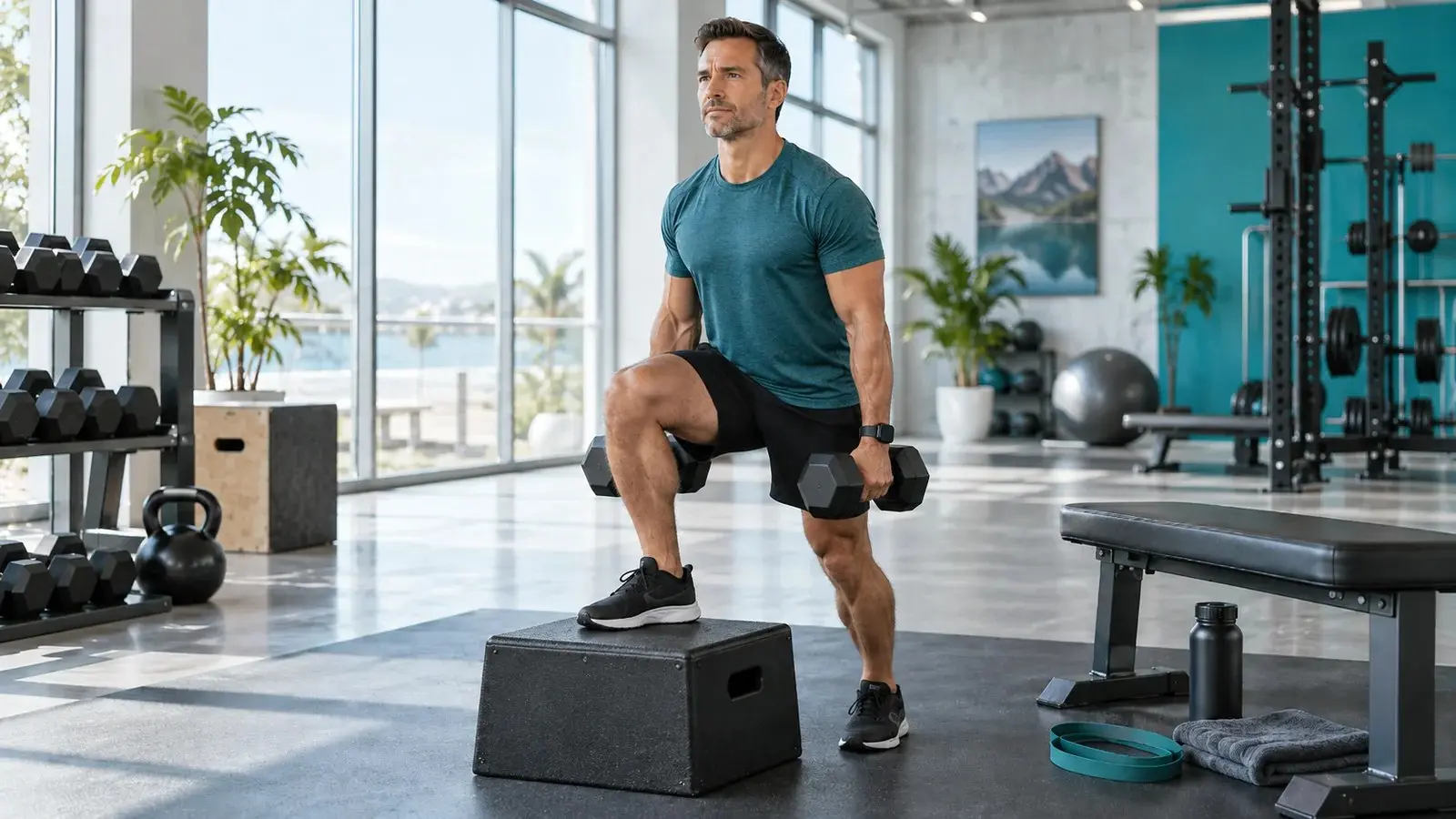
Step-up onto a low step
Glutes · QuadricepsPlace your whole foot on a low, firm step. Step up with control and lower yourself slowly. Use a railing or another stable handhold until you can also control the descent safely.
- Easier: a lower step, supported weight shifts or fewer repetitions.
- Harder: a slightly higher step, less hand support or light weights.
- Common mistake: pushing off strongly with the back foot or dropping off the step.
2 sets of 6–10 repetitions per side. A low step is entirely sufficient to begin with.
Lateral mini-band steps
Lateral glutesPlace a light mini band around your thighs above your knees. Bend your hips and knees slightly, keep your pelvis still and take small sideways steps. Bring the second leg across with control rather than letting the band pull it back.
- Easier: walk sideways without a band or lift one leg out to the side while standing.
- Harder: a slightly stronger band or more controlled steps.
- Common mistake: using so much resistance that your torso and pelvis sway strongly.
2 rounds of 8–12 small steps in each direction. Quality matters more than band resistance.
Supported calf raises
Calves · Push-offHold a fixed worktop or railing. Slowly lift both heels, pause briefly at the top and lower them to the floor with control. Stay centred over your feet without tipping forwards or bouncing.
- Easier: a smaller range of motion and more hand support.
- Harder: a single-leg variation, extra weight or later calf raises at the edge of a step.
- Common mistake: fast, bouncing repetitions without a controlled descent.
2 sets of 10–15 repetitions. Lift for two seconds, hold briefly and lower for two seconds.
The FitRecover training plan for two days per week
Train on two non-consecutive days. During the first week, you can begin with one set per exercise. Two sets are a sensible next step afterwards. Allow approximately 30–40 minutes, including your warm-up and rests.
| Exercise | Getting started | Target range | Rest |
|---|---|---|---|
| Chair squat | 1 × 8 | 2 × 8–12 | 60–90 sec |
| Glute bridge | 1 × 10 | 2 × 10–15 | 60–90 sec |
| Hip hinge / Romanian deadlift | 1 × 8 | 2 × 8–12 | 60–90 sec |
| Reverse lunge | 1 × 6 per side | 2 × 6–10 per side | 60–90 sec |
| Step-up | 1 × 6 per side | 2 × 6–10 per side | 60–90 sec |
| Lateral mini-band steps | 1 × 8 in each direction | 2 × 8–12 in each direction | 45–75 sec |
| Calf raises | 1 × 10 | 2 × 10–15 | 45–75 sec |
If seven exercises are too much at first: Begin with squats, glute bridges, hip hinges, mini-band steps and calf raises. Add lunges and step-ups later. A short plan you can follow consistently is more valuable than an oversized plan you abandon.
How to actually get stronger
Building muscle and strength requires gradual progression. You do not have to train to complete muscular failure.
- Start with a load that would leave approximately two or three clean repetitions in reserve at the end of a set.
- When you reach the top of the repetition range with control in two sessions, increase only one variable: repetitions, an extra set, weight, band resistance or range of motion.
- Do not increase weight, depth and training volume at the same time.
- Record the exercise, variation, repetitions and weight. This makes progress visible.
Useful training aids for your glutes and legs
You do not need a fully equipped training room. A stable chair and a secure step are enough to start. These aids can make training more comfortable and progression easier later on.
Non-slip exercise mat
For glute bridges and kneeling preparation. Look for secure grip and cushioning suited to your floor and knees.
View mats on Amazon*Mini-band set with a light resistance option
A genuinely light band is often more useful for controlled lateral steps than maximum resistance. Check the material before every use.
View mini bands on Amazon*Dumbbell or kettlebell
For goblet squats, Romanian deadlifts and later lunges. Choose comfortable grips and clearly defined weight increments.
View weights on Amazon*Low step platform
Only needed if no safe step is available. The platform should be non-slip, adequately load-rated and suitable for slow step-ups.
View step platforms*Advertising / affiliate disclosure: Links marked with * are Amazon affiliate links. As an Amazon Associate, I earn from qualifying purchases, at no extra cost to you. These links lead to product categories, not to a specific product tested by FitRecover.
Frequently asked questions
How often should I train my glutes and legs?
Two sessions per week on non-consecutive days are a practical starting rhythm. Adapt volume and load to your current level and recovery.
Are squats alone enough?
Squats work many large muscles but do not challenge every function equally. Glute bridges or hip thrusts, hip hinges, single-leg exercises, lateral hip work and calf raises complement them well.
Do I need muscle soreness for the training to work?
No. Soreness is not a necessary sign of effectiveness. Consistent sessions, controlled repetitions and measurable progression over weeks matter more.
Can I get stronger without equipment?
Yes. Body weight, a stable chair and a firm step are enough to begin. When the repetitions become easy, first improve your range and control, then add resistance later.
Your next step
Choose two training days, start with a manageable variation and record your repetitions. This turns a selection of exercises into a real strength programme.
Subscribe to FitRecover on YouTubeSources and context
- American College of Sports Medicine: Resistance Training Guidelines Update 2026.
- Currier et al. (2026): Resistance Training Prescription for Muscle Function, Hypertrophy, and Physical Performance in Healthy Adults.
- NHS: Strength exercises.
- NHS: Balance exercises.
- Plotkin et al. (2023): Hip thrust and back squat training elicit similar gluteus muscle hypertrophy.
- World Health Organization: Physical activity.
Editorial update: 9 September 2026. The specific FitRecover plan, exercise selection and starting dosage are editorial suggestions for healthy adults and have not been clinically tested as a complete programme. The illustrations were created using AI for FitRecover; the weights and ranges of motion shown are not prescribed targets.