
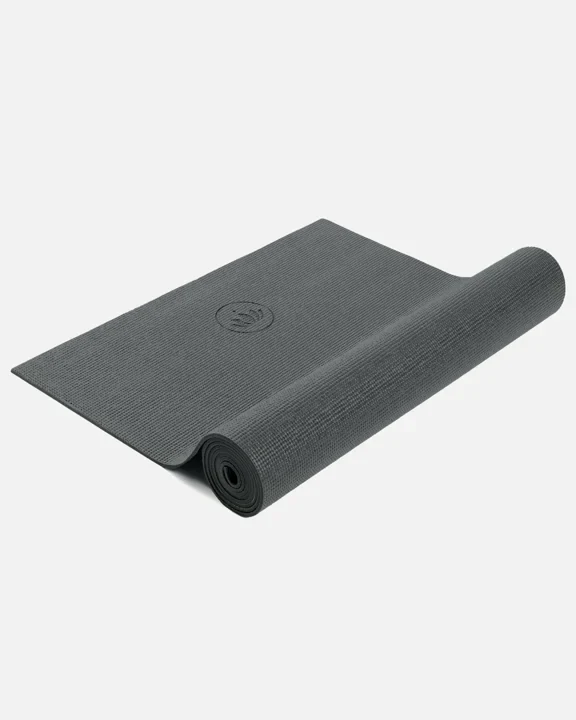
For floor exercises
Lotuscrafts MUDRA Studio
A 5 mm mat for dead bugs, glute bridges and controlled core exercises.
View on Amazon.deA practical training guide
Between work, family and everyday life, do you only have time for strength training twice a week? You can build a useful plan around that. What matters is choosing sessions that match your ability, cover the major muscle groups and become more demanding over time. Two sessions can help you make progress. They do not guarantee maximum muscle growth or a particular appearance.
Go to the training plan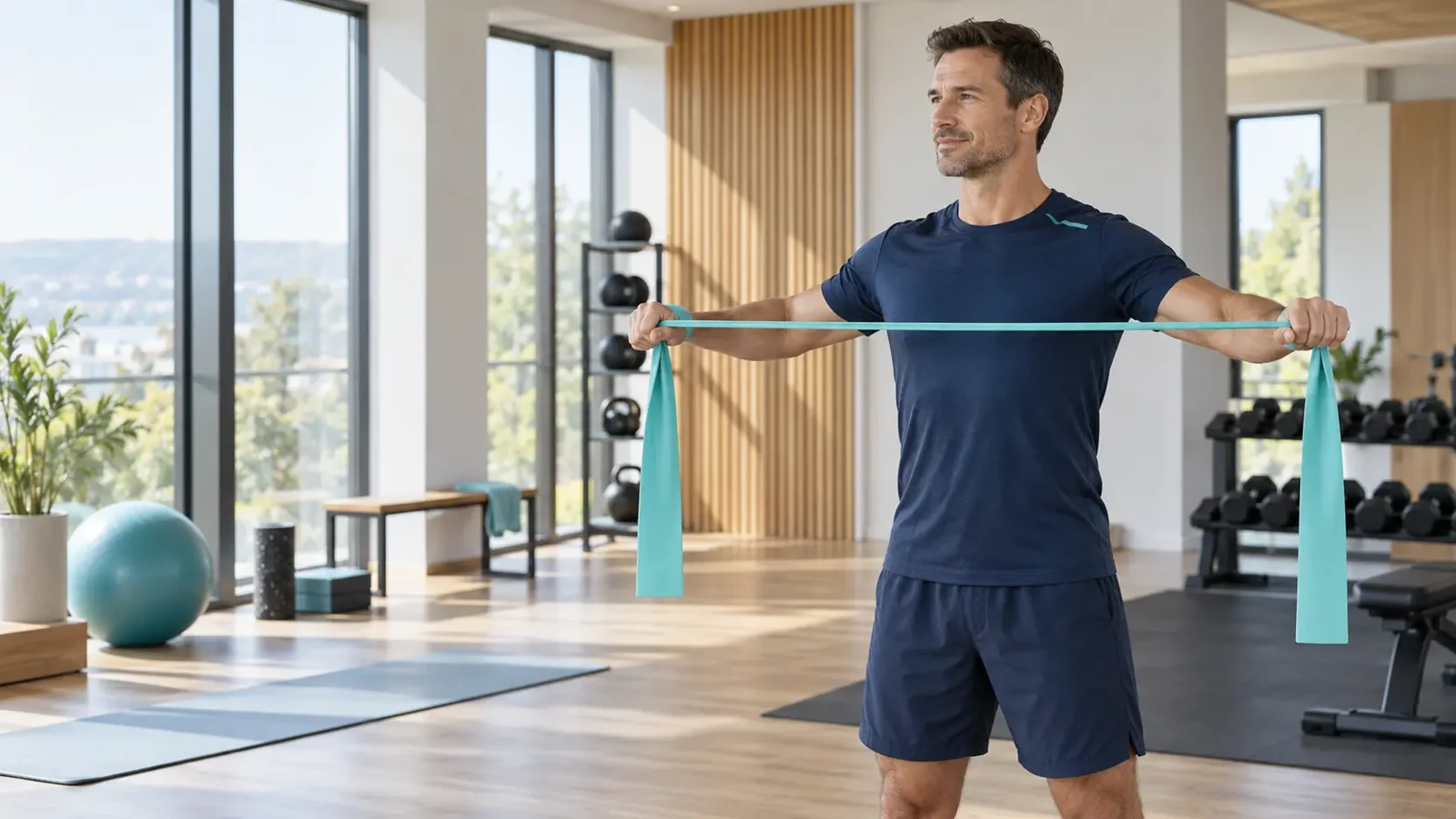
Optional additions for controlled floor exercises, pulling movements and adjustable resistance.
For floor exercises
A 5 mm mat for dead bugs, glute bridges and controlled core exercises.
View on Amazon.de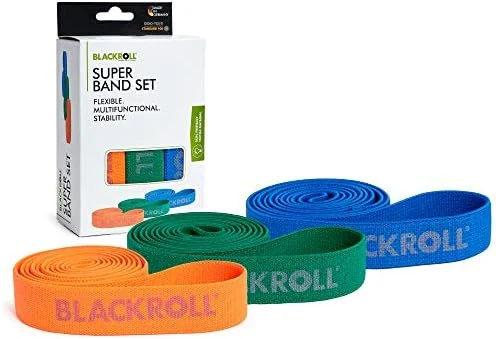
For adjustable resistance
Three long fabric resistance bands with different resistance levels.
View on Amazon.de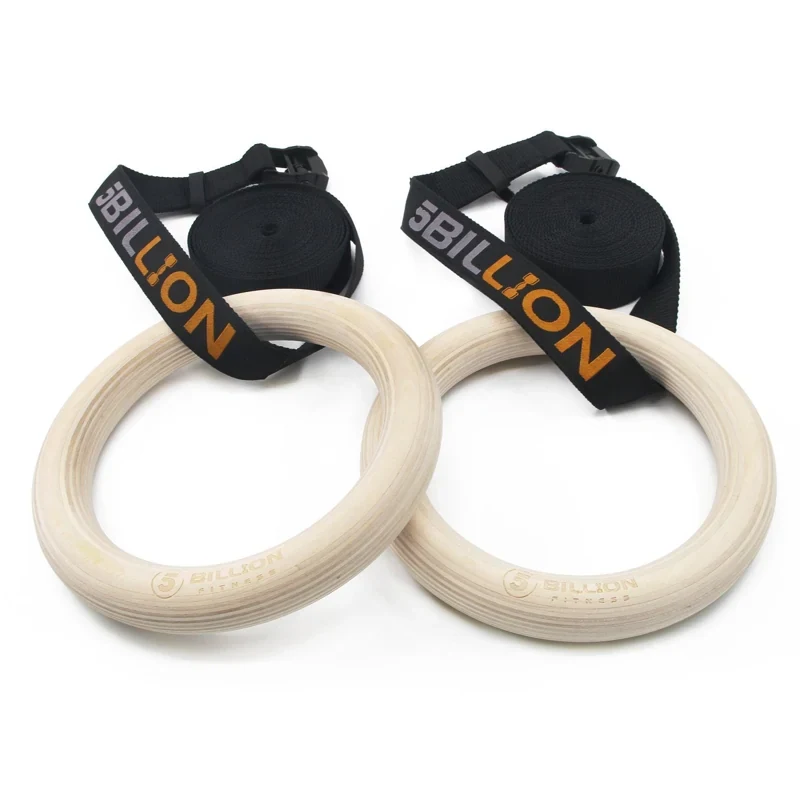
For rows with feet on the floor
Height-adjustable straps for low ring rows.
View on Amazon.deAdvertisement · The Amazon links are affiliate links. As an Amazon Associate I earn from qualifying purchases. You do not need to buy these products to follow the plan.
The current ACSM recommendations emphasise regular strength training with gradual progression. Bodyweight exercises and resistance bands can also be effective. For many healthy adults, training the major muscle groups at least twice a week is a practical starting point. [1]
How much you achieve depends on factors such as training volume, effort and recovery. A meta-analysis on muscle hypertrophy found no meaningful independent effect of training frequency when weekly volume was equal. In other words, more training days do not automatically give you an advantage. They can, however, help you spread more high-quality work across the week. [2]
With a two-day split consisting of one upper-body and one lower-body day, each area is targeted on only one day. If you miss that session, the gap becomes much longer. With two full-body sessions, you train your legs, upper body and core on both days. A split routine can also work; when sessions are limited or your schedule varies, a full-body plan is often easier to organise.
Pushing, pulling and a leg exercise provide a time-efficient foundation. [3] For the sample plan below, we add a hip-extension movement and a controlled core exercise. That gives each session five clearly defined tasks.
| Movement | A simple starting point | What to focus on |
|---|---|---|
| Push | Incline push-up | Move your whole body with control |
| Pull | Row using a fixed low bar | Choose a body angle that matches your ability |
| Knees and legs | Squat or supported split squat | Keep a stable stance and control the depth |
| Hip extension | Glute bridge on the floor | Lift your hips without over-arching your lower back |
| Core | Dead bug or short side plank | Breathe steadily and maintain your position |
For example, train on Mondays and Thursdays. Initially, allow about 35 to 45 minutes per session. The time depends on rest periods, exercise changes and your pace. The following is a general starting suggestion for healthy adults and should be adjusted to your capacity.
Start with about five to eight minutes of easy movement and suitable light preparation exercises: for example, marching on the spot, gentle shoulder and wrist movements, simple squats and an easy practice set of the first exercises. Increase the range of motion and resistance gradually. Preparation can help you assess how you feel that day; it does not guarantee protection against injury.
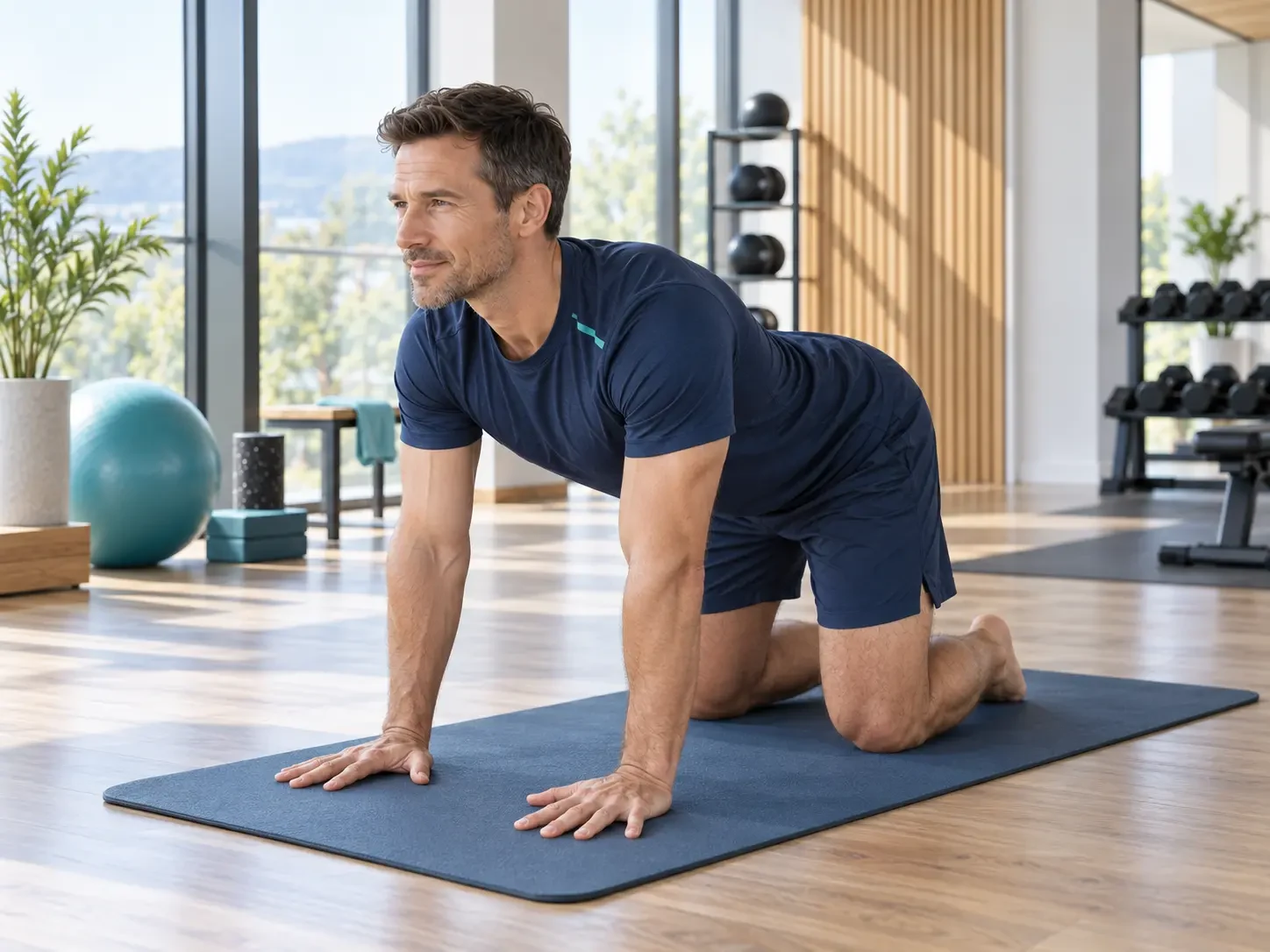
| Exercise | Sets and reps | Easier variation |
|---|---|---|
| Squat | 2 × 8–12 | Sit down onto a stable bench with control |
| Incline push-up | 2 × 6–12 | Place your hands on a higher, fixed surface |
| Low-bar row | 2 × 6–12 | Stand more upright to make the pull easier |
| Glute bridge | 2 × 10–15 | Choose a smaller range of motion that you can control well |
| Dead bug | 2 × 6–10 per side | Keep your arms still and move only your legs at first |
| Exercise | Sets and reps | Easier variation |
|---|---|---|
| Supported split squat | 2 × 6–10 per side | Hold on for support and use a shallower depth |
| Row or assisted pull-up | 2 × 6–10 | Stick with the row you already know |
| Incline push-up | 2 × 6–12 | Use the raised surface from session A |
| Glute bridge | 2 × 10–15 | Keep both feet securely on the floor |
| Side plank | 2 × 15–25 seconds per side | Start with bent knees |
Rest for about 90 to 120 seconds between working sets, or longer if needed. Take a short breather when changing sides. Initially, stop dynamic sets with about two to three technically sound repetitions in reserve. For holds, stop before your position breaks down. If two sets are too much, start with one.
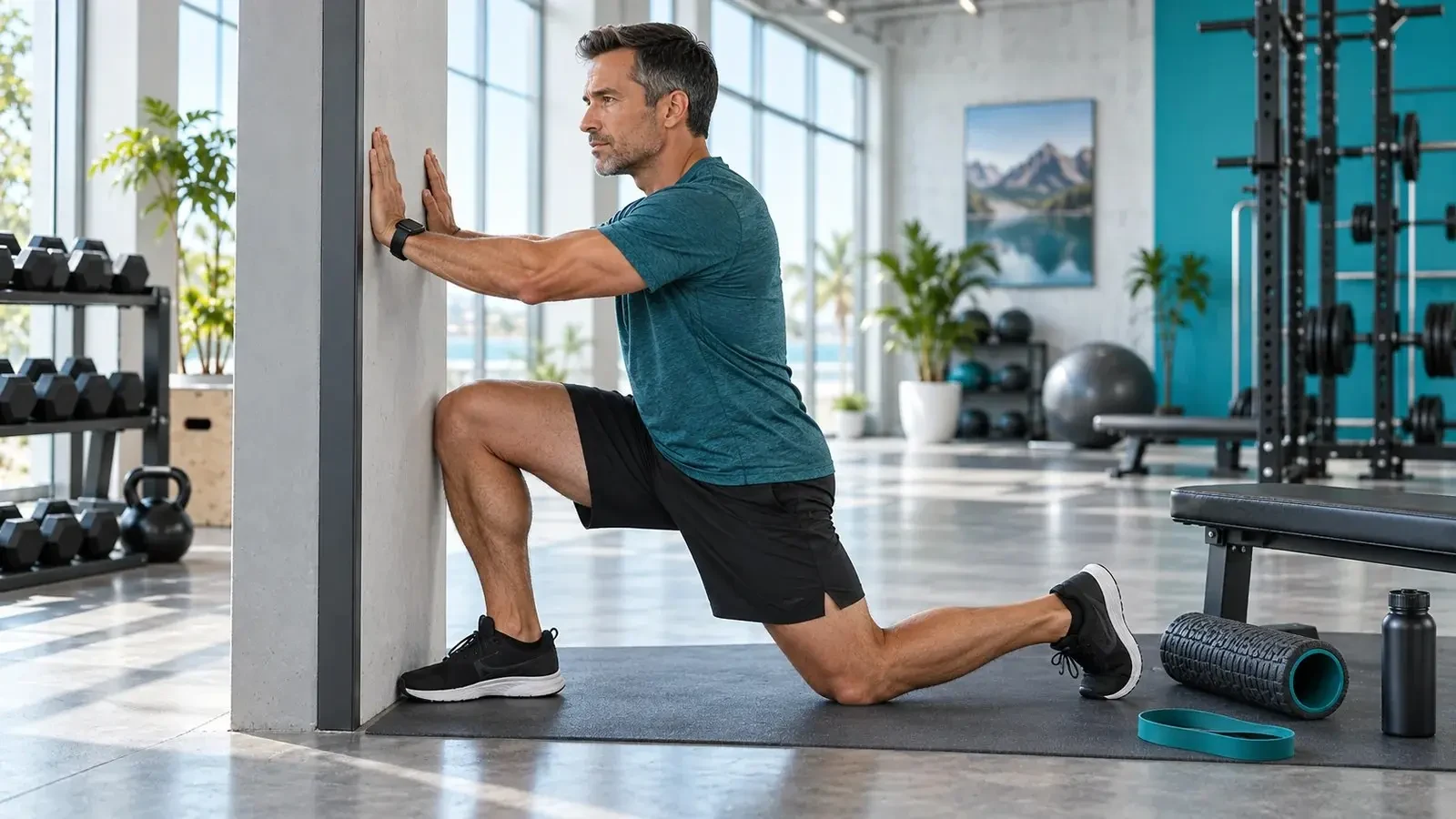
Record the exercise variation, repetitions and how hard the set felt. Keep the same movements at first. When you can complete every set at the top of the range with control in two consecutive sessions, and still have repetitions in reserve, change one factor: for example, use a lower surface for push-ups or a more horizontal body position for rows. Your repetition count can then drop again.
The first few weeks are mainly about finding an appropriate load and reliable technique. For example, you start with two sets of six incline push-ups. Later, you manage two sets of seven, then two sets of eight. You do not need to train to muscular failure every session or choose a new exercise every week. [1]
Normal exertion is different from sharp or increasing joint pain. Stop a painful repetition and check whether an easier variation is possible without pain. Recurring or persistent symptoms should be assessed by a qualified professional. Reaching a particular age does not automatically require a break or a fixed four- to six-week preparation programme. What matters is your starting point and how you respond to the load.
Continue the plan at the next suitable opportunity. You do not need to squeeze the missed work into an especially hard catch-up session. Two regular sessions over several months give you more useful feedback than a brief start with a workload you cannot sustain.
Two strength sessions do not automatically replace aerobic activity. The WHO also recommends that adults get 150 to 300 minutes of moderate-intensity activity or 75 to 150 minutes of vigorous-intensity activity per week, or an equivalent combination. Brisk walking, cycling or other suitable activities can be spread across the week. [4]
Do I need to be able to do dips and pull-ups? No. Incline push-ups and appropriately scaled rows can be your starting point. More demanding variations become relevant when you have the necessary control and capacity.
Are two days enough for advanced trainees too? They can work. With ambitious goals or very high training volumes, extra sessions can make it easier to distribute the work. Judge whether you need more based on your progress, recovery and available time.
Do I need a lot of equipment? For this plan, a safe training space with fixed supports for pushing and pulling, plus some floor space, is enough. Loose furniture or unchecked anchors are not suitable pulling stations. A gym is another possible setting.
Product information: Lotuscrafts MUDRA, BLACKROLL SUPER BAND Set, 5BILLION gymnastic rings. Training images: FitRecover illustrations. Product images: Lotuscrafts, BLACKROLL and 5BILLION.