CAMP Ice Master Pro
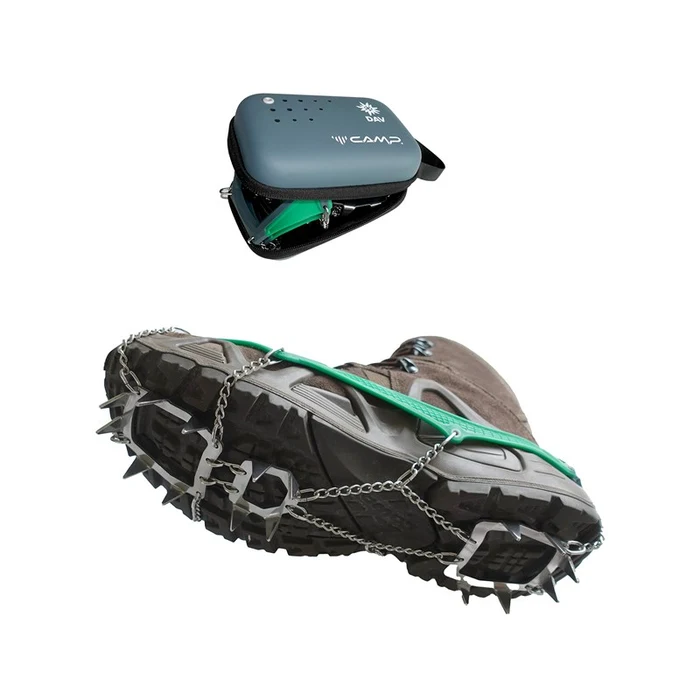
CAMP Ice Master Pro is our first candidate for ordinary winter paths. Fitting it to your own footwear remains essential.
Search Amazon.deOutdoors · Winter hiking · Buying guide
Better footing on icy paths starts with equipment that fits. Discover which traction devices suit your walks, how to check the fit and what separates ten well-known models.
Advertising / affiliate links: As an Amazon Associate, FitRecover earns from qualifying purchases at no extra cost to you. Yellow links open a search for the named model on Amazon.de; select the correct version and size there.
Ice cleats stretch over your footwear. Their metal points can improve traction on ice and packed snow. Cleared pavements, deep powder and steep mountain terrain call for different solutions, however. Start with your intended route before comparing spike counts, weight and price.
CAMP Ice Master Pro is our first candidate for ordinary winter paths. Fitting it to your own footwear remains essential.
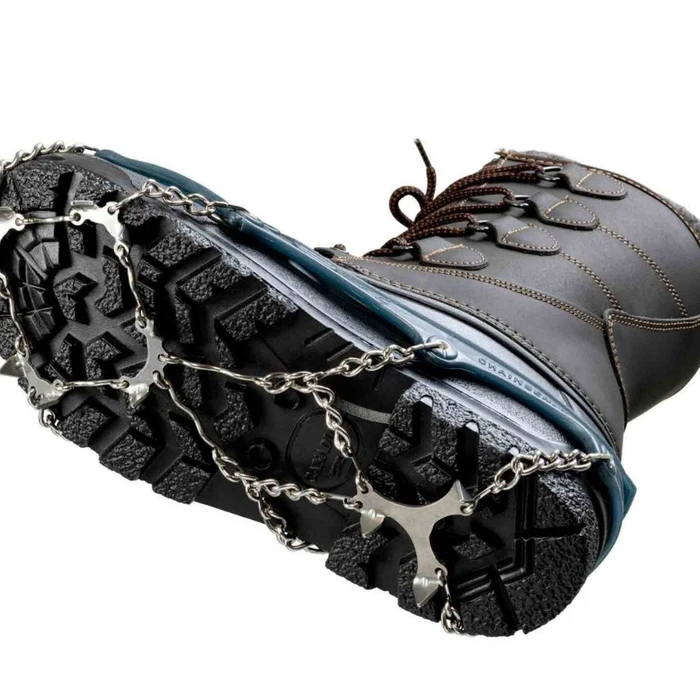
Search Amazon.deSnowline Chainsen Pro suits people who prefer a substantial construction and a firm heel section.
Search Amazon.de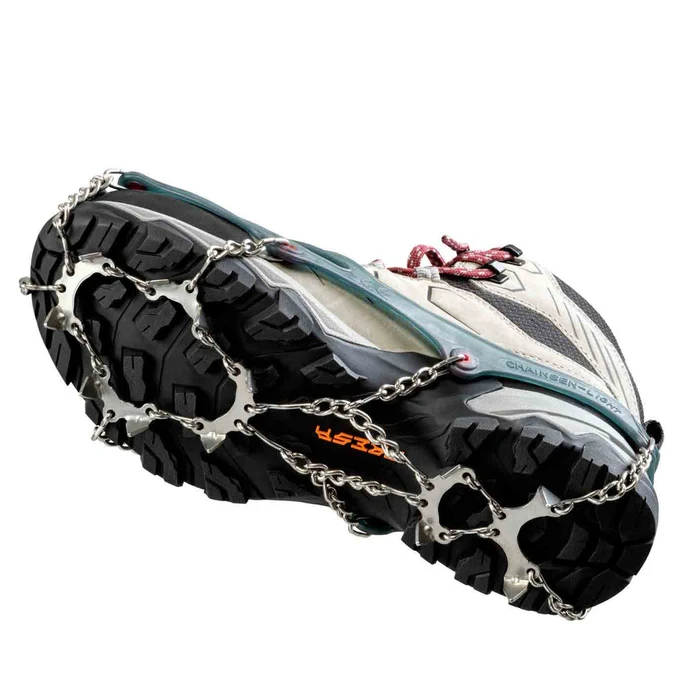
Snowline Chainsen Light is worth considering if you often carry your cleats in a pack and use lighter footwear.
Search Amazon.deRetail names overlap. Look at the construction and instructions, rather than relying on the product name alone.
Small spikes can be practical for short icy everyday walks. Frequent transitions between ice, bare pavement and buildings make long points less convenient.
The focus of this comparison: flexible stretch-on devices with chains and points under the forefoot and heel, for suitable winter walking routes.
Technical routes demand a different combination of boots, bindings and skills. The stretch-on devices here do not replace that equipment.
| Rank / model | Focus | Trade-off |
|---|---|---|
| 10Stubai Mount Track | Substantial build with strap | More weight and fastening steps |
| 09CAMP Ice Master Run | Winter running | Running-specific design |
| 08Snowline Chainsen Light | Lightweight luggage | Footwear volume matters |
| 07Grivel Explorer | Substantial construction | Relatively heavy pair |
| 06Salewa Pedroc Mountain Spike | Speed hiking | Specialised construction |
| 05Salewa Mountain Spike (MTN Spike) | Conventional winter hiking | More material than running designs |
| 04Nortec Nordic 2.4 | Short, distributed points | Check the generation |
| 03Kahtoola MICROspikes | Regular hiking | Not a minimalist choice |
| 02Snowline Chainsen Pro | Sturdy hiking boots | Substantial harness over low weight |
| 01CAMP Ice Master Pro | All-round candidate | Fit remains individual |
This is an editorial comparison, not our own field test or an exhaustive survey of Amazon's catalogue. It draws on linked product information and published testing. The ranking prioritises ordinary winter hiking, handling and construction over weight alone. A running specialist may therefore suit a runner better than our number one. Always check the exact version being sold when a product has been updated.
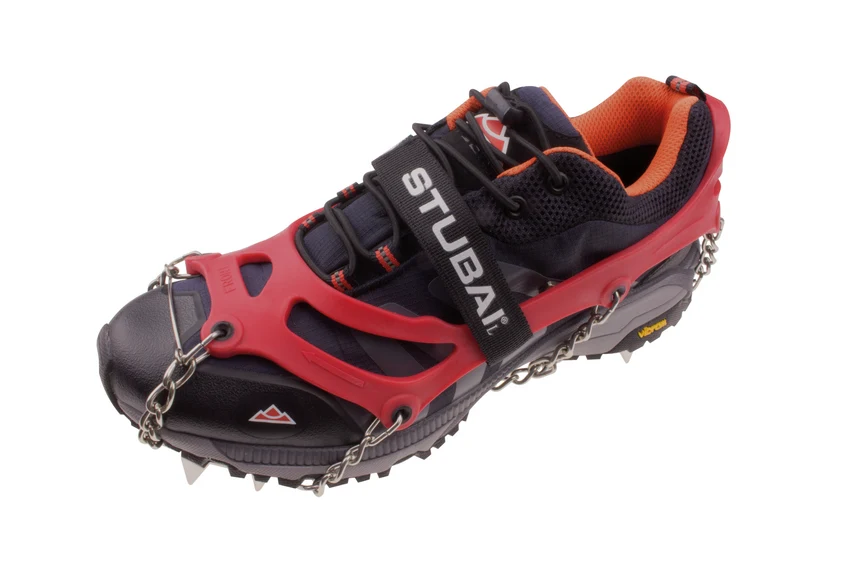
The Mount Track has 14 points and an extra fastening strap. Stubai lists 510 g for size M, placing it outside the lightweight group.
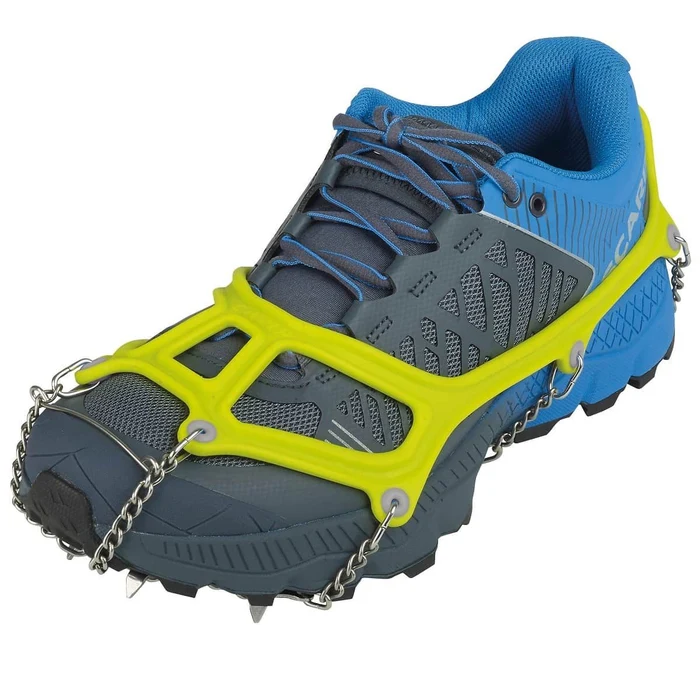
CAMP specifies thirteen 8 mm points and 188 g per pair in size L for the Ice Master Run. Winter running is its clear focus.
The current Snowline LIGHT version has twelve 12 mm points according to the brand. Its slim harness is geared towards lighter footwear.
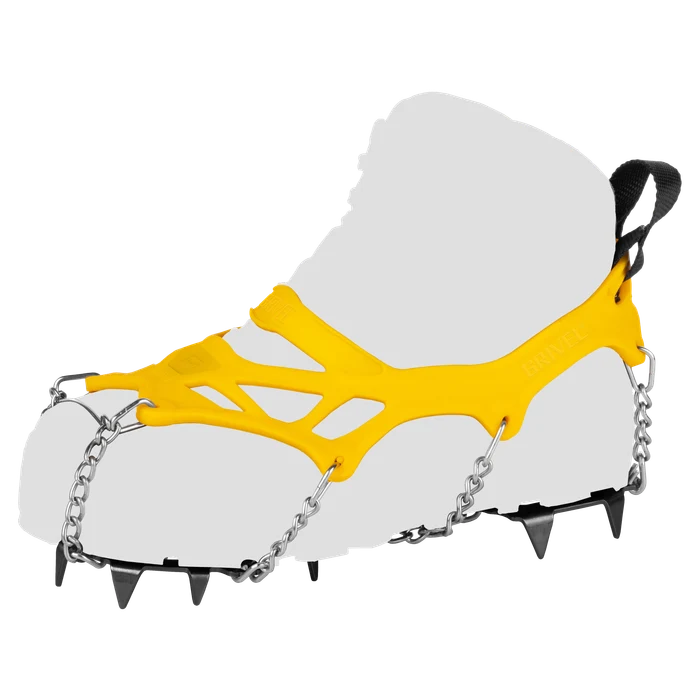
Grivel Explorer combines 14 steel points with a rubber harness and textile connections. Grivel lists 476 g per pair in size M.
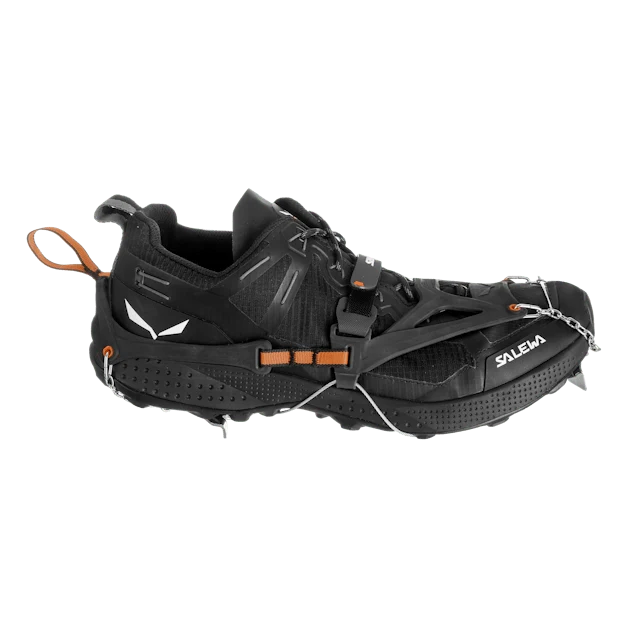
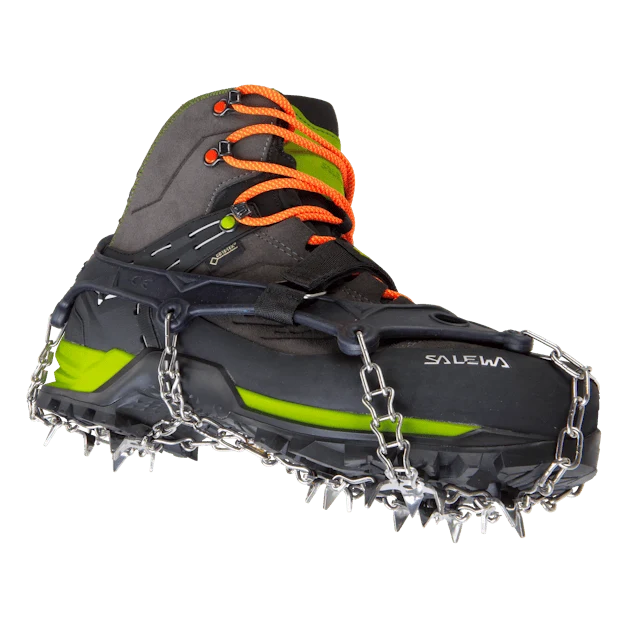
Salewa specifies nine points linked by steel cables and chains. A hook-and-loop strap adjusts the forefoot and midfoot fit.
Salewa MTN Spike has 18 stainless-steel points and comes with a storage bag. It is distinct from the brand's Pedroc model.
Nortec specifies twenty-one 8 mm points for Nordic 2.4. This is a different approach from longer-point designs.
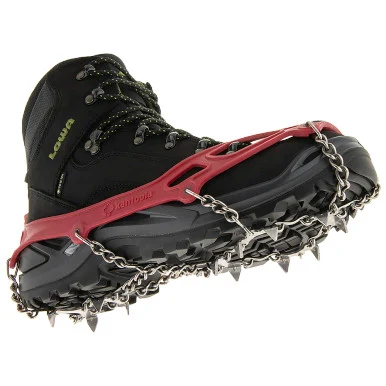
Kahtoola specifies twelve stainless-steel points per foot and reinforced harness eyelets. A front bail limits the toe moving forwards through the harness.
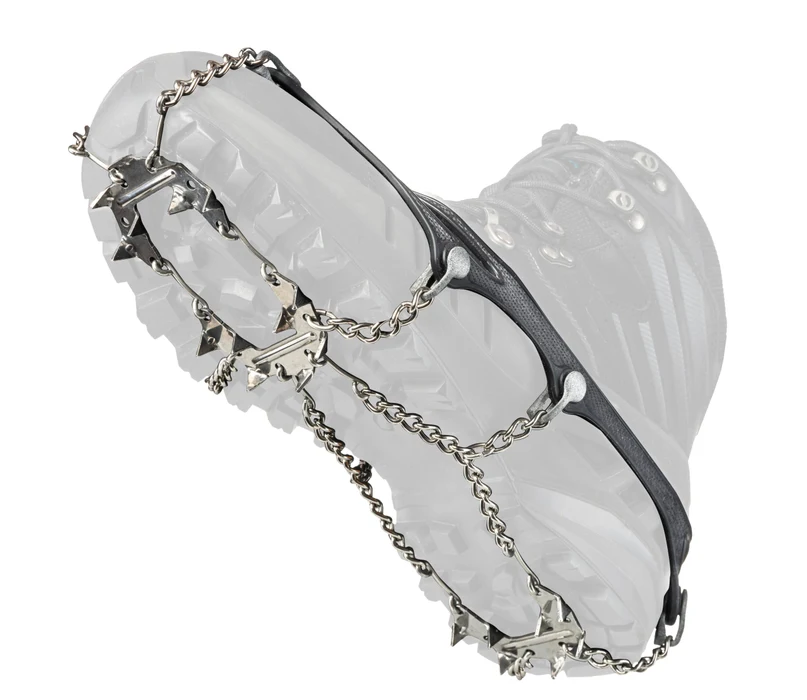
Snowline PRO combines eleven points with a firm heel plate. The brand provides separate sizing guidance for lightweight and insulated footwear.
F.A.Z. Kaufkompass selected CAMP Ice Master Pro as its favourite among 23 tested models, highlighting fit and handling. This supports our first recommendation for ordinary winter walking.
Use the specific model's size chart. An insulated winter boot takes up more space than a narrow running shoe of the same EU size. The harness should sit evenly; chains must not hang loosely at the sides or visibly overstretch the harness. At a size boundary, trying both options is more useful than a general sizing rule.
Fit both devices as instructed and align the spike plates under the soles. Recheck after a few steps on safe, appropriate ground. If the heel slips, a plate rotates or the harness presses awkwardly against the shoe, change the size or model.
Point count is not a traction measurement. Length, shape, placement, snow conditions and fit interact. Short points and a low profile may feel comfortable when walking; longer points still do not make steep ice safe. Deep powder presents a separate problem.
Put the cleats on in a safe place before reaching the slippery section. Move deliberately and avoid abrupt changes of direction. Remove them before shops and on smooth indoor floors: metal may slip and damage surfaces. Longer snow-free sections are also a reason to pack them away.
Remove dirt and salt after use following the maker's instructions. Dry fully, inspect eyelets, chains and rubber, then store in a protective bag. Cracks, open connections and heavily worn points are reasons to have the device checked or replaced before using it again.
Some fit lightweight shoes, but they do not turn trainers into warm, supportive winter footwear. Check the manufacturer's guidance and the actual fit.
A correctly fitting device may provide extra grip on suitable paths. Safe fitting, balance and removal before entering buildings also matter. If mobility is limited, fitting while seated and with help should be possible.
Only with an explicitly suitable size and a secure fit. An oversized adult device is unsuitable. Practise fitting and walking together before a trip.
Follow the instructions for short transitions. Many chain cleats are uncomfortable and wear unnecessarily on longer cleared sections. Remove them on indoor floors.
No. Cleats engage suitable firm ground. Snowshoes spread your weight over a larger area to reduce sinking.
For ordinary winter hiking, CAMP Ice Master Pro, Snowline PRO or Kahtoola MICROspikes. Also consider Snowline LIGHT for light packing and CAMP Ice Master Run for winter running.
CAMP Ice Master Pro is our first all-round candidate, Snowline PRO an alternative for sturdy boots and Snowline LIGHT an option for lighter luggage. Choose the model that fits your footwear correctly and matches your routes. A lower rank is no disadvantage when its specialisation suits your needs.
Product information and photo sources are linked beside each model. Research date: 13 November 2026. Pictured colours may differ from the selected offer.